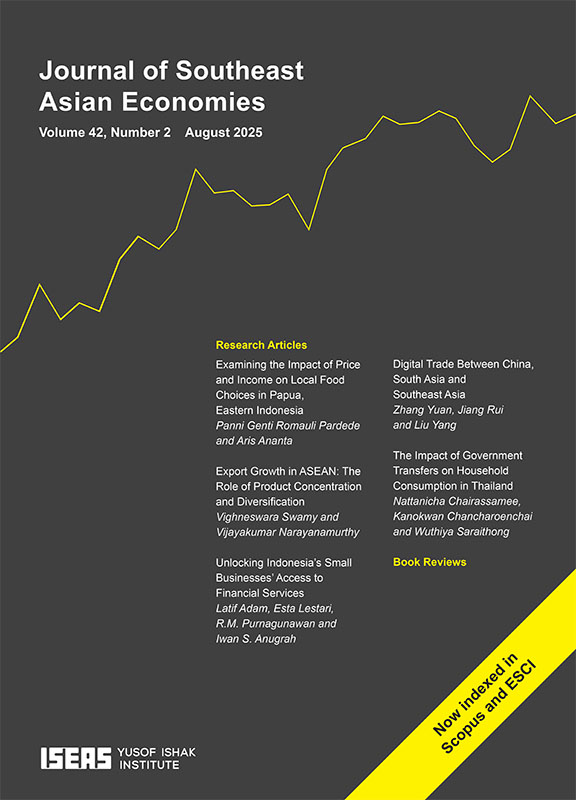
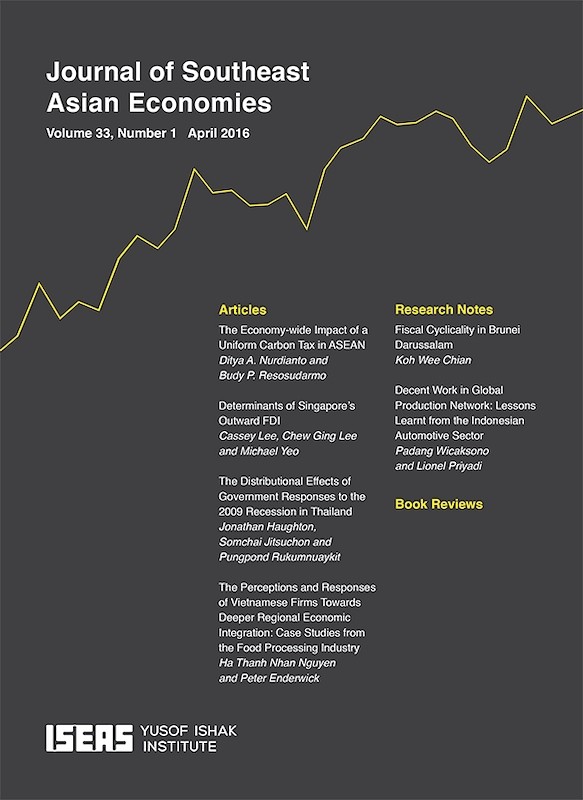
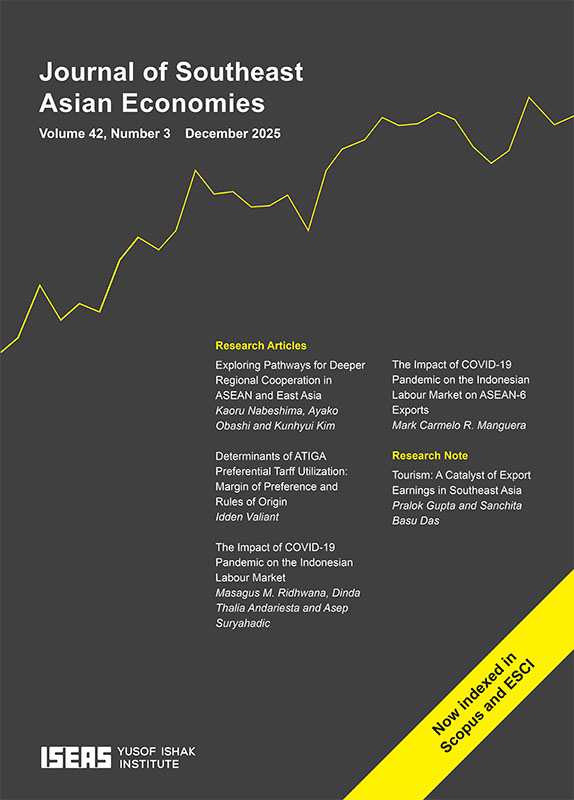
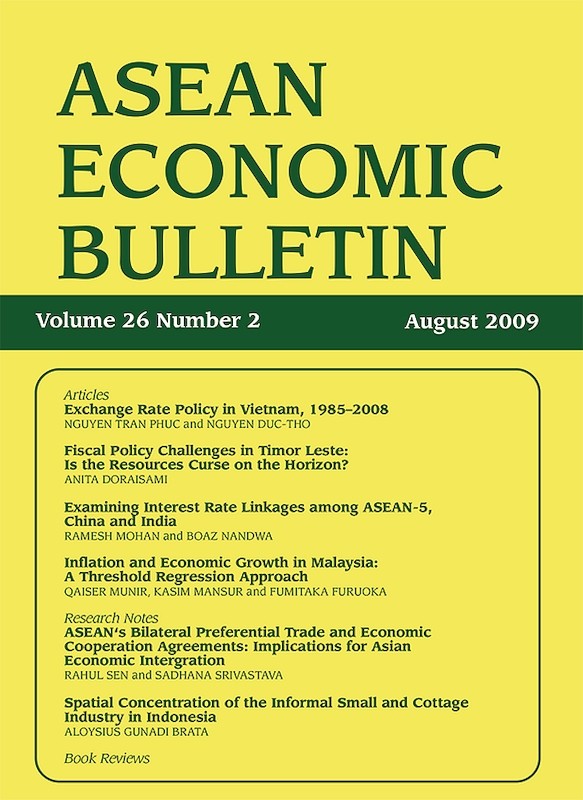
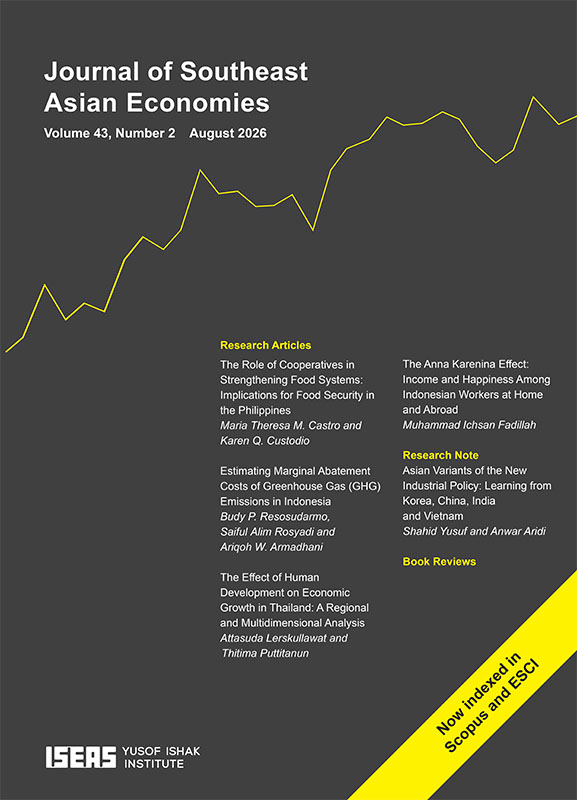
Journal of Southeast Asian Economies Vol. 43/2 (August 2026)
Date of publication:
August 2026
Publisher:
ISEAS – Yusof Ishak Institute
Number of pages:
112
Code:
AE43/2
Soft Cover
ISSN: 23395095

Contents
-
Journal of Southeast Asian Economies Vol. 43/2 (August 2026)
[Whole Publication, ISSN: 23395200] -
Preliminary pages
- RESEARCH ARTICLES
-
The Role of Cooperatives in Strengthening Food Systems: Implications for Food Security in the Philippines, by Maria Theresa M. Castro, Karen Q. Custodio, authors see abstractCooperatives are increasingly recognized as institutional vehicles for advancing food security, yet evidence on how they engage local food systems remains limited. Grounded in collective action and institutional theories, this study advances the proposition that cooperatives, as institutional forms of collective action, can strengthen food system governance in ways that potentially support food security. Using a descriptive–interpretive design, evidence was gathered through focus group discussions, a cooperative member survey and a validation workshop in Oriental Mindoro, Philippines—a province paradoxically marked by agricultural abundance and yet persistently experiences food insecurity. Findings reveal that cooperatives are active across all food system stages, with members perceiving meaningful contributions to food security. An enabling legal and policy environment supports cooperative engagement. However, multilevel constraints, including limited capital, weak intercooperative collaboration and policy imbalances persist, limiting their full potential. As these findings reflect perceived rather than causally established contributions, the study concludes that harnessing cooperatives as agents of food system transformation requires coherent institutional frameworks, nutrition-sensitive programming and multilevel partnerships that move beyond production-oriented support. These findings offer transferable lessons for other ASEAN countries where cooperatives remain underutilized as instruments of food system governance.
-
Estimating Marginal Abatement Costs of Greenhouse Gas (GHG) Emissions in Indonesia, by Budy P. Resosudarmo, Saiful Alim Rosyadi, Ariqoh W. Armadhani, authors see abstractThis paper provides the first economy-wide, subnational estimates of the marginal abatement cost (MAC) of greenhouse gas emissions for Indonesia. Using a production-function approach applied to a district-level panel dataset covering 2010–2015, we estimate a national average MAC of USD 18.85 per ton of CO2 e (95 per cent confidence interval: USD 13.33–24.36). Substantial regional heterogeneity is documented, ranging from USD 4.37 per ton of CO2 e in Sumatra to USD 139.33 per ton of CO2 e in Maluku-Papua. The estimated MAC is nearly five times the prevailing carbon price on Indonesia’s Carbon Exchange, signalling that current carbon pricing is insufficient to incentivize meaningful abatement. The economic cost of achieving Indonesia’s Paris-aligned mitigation pathway is estimated at USD 26–47 billion by 2050, modest relative to climate damage costs of USD 312–436 billion if action is deferred. The findings provide an empirical foundation for calibrating Indonesia’s carbon-pricing instruments, designing spatially differentiated mitigation strategies and demonstrating that the costs of ambitious climate action are small relative to the costs of inaction.
-
The Effect of Human Development on Economic Growth in Thailand: A Regional and Multidimensional Analysis, by Attasuda Lerskullawat, Thitima Puttitanun, authors see abstractThis study examines the effect of human development on economic growth in Thailand from 2015 to 2022 using provincial-level data from all seventy-seven provinces and a System-GMM estimation framework. While the overall human development, measured by the Human Achievement Index (HAI), shows no statistically significant effect on economic growth, disaggregating the index reveals that specific dimensions, namely work-life, housing and environment, and transportation and communication, are significant economic growth drivers. Regional analysis indicates that these effects are dimension-specific: education and work-life drive growth in the northeast and south; housing and environment are critical in the central region; transportation and communication in the north and northeast; and health in the north. The study also finds that financial development and the Covid-19 pandemic have negatively impacted economic growth. These findings advocate for regionally differentiated policies that target specific human development dimensions to foster sustainable growth.
-
The Anna Karenina Effect: Income and Happiness Among Indonesian Workers at Home and Abroad, by Muhammad Ichsan Fadillah, author see abstractThis study examines how the income-happiness relationship differs between Indonesian workers in Indonesia and Indonesian migrants in Poland. Results reveal a flat income-happiness curve in Indonesia but a steep gradient in Poland, with the standardized income effect statistically distinguishable from zero among migrants but not among domestic workers. The proportion achieving happiness without high income falls from about 30 per cent in Indonesia to about 15 per cent in Poland. These patterns are interpreted through the Anna Karenina principle: Indonesia represents an “overdetermined” system, in which multiple pathways to well-being exist so that no single resource is essential, while Poland represents a “bottleneck” system, in which income becomes a necessary condition because alternative pathways are foreclosed. The pattern is consistent with migration foreclosing non-income pathways.
- RESEARCH NOTE
-
Asian Variants of the New Industrial Policy: Learning from Korea, China, India and Vietnam, by Shahid Yusuf, Anwar Aridi, authors see abstractIndustrial Policy (IP) has staged a remarkable comeback. It is enjoying a renaissance because Emerging Market and Developing Economies (EMDEs) and Advanced Economies (AEs) have been unable to shake off the post-financial crisis economic doldrums, and market forces are not delivering the desired outcomes. The early version of Industrial Policy (IP1.0), which achieved both success and notoriety in the last quarter of the twentieth century, is morphing into IP2.0. The latest policy retains some of the distinctive elements of its predecessor; however, the sectoral coverage has broadened under IP2.0. Additionally, IP2.0 assigns primacy to research, development and innovation (RD&I) as the driver of productivity and growth, and it is being shaped by pressures arising from a fracturing global environment. In this paper, we feature four Asian countries—South Korea, China, India and Vietnam—to further define the variegated elements of IP2.0 and show how it is being deployed by countries of different sizes and at different stages of development. Their experiences offer valuable lessons for other EMDEs in Southeast Asia.
- BOOK REVIEWS
-
Entrepreneurship in Singapore: Case Studies, History and Ecosystem, edited by Jürgen Rudolph, Robert Fitzgerald, Choon-Yin Sam and Ailson J. De Moraes, by Francis E Hutchinson, author
-
Industrial Policy for Development: Approaches in the 21st Century, by Ana Margarida Fernandes and Tristan Reed, by Marco Kamiya, author