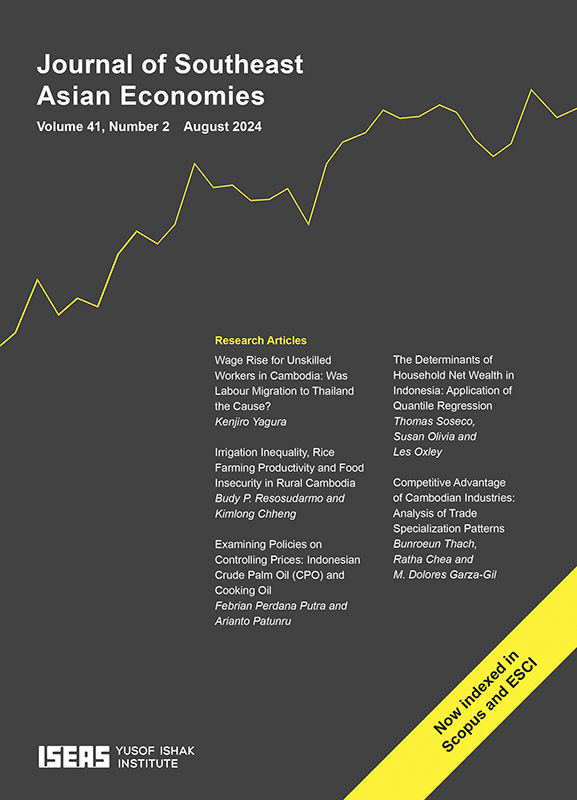
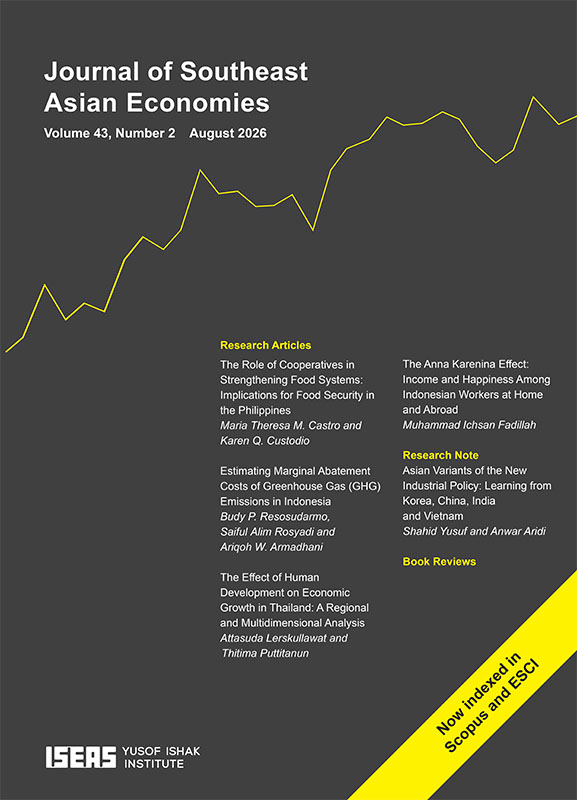
Journal of Southeast Asian Economies Vol. 42/2 (August 2025)
Date of publication:
August 2025
Publisher:
ISEAS – Yusof Ishak Institute
Number of pages:
117
Code:
AE42/2
Soft Cover
ISSN: 23395095

Contents
-
Journal of Southeast Asian Economies Vol. 42/2 (August 2025)
[Whole Publication, ISSN: 23395200] -
Preliminary pages
- RESEARCH ARTICLES
-
Examining the Impact of Price and Income on Local Food Choices in Papua, Eastern Indonesia, by Panni Genti Romauli Pardede, Aris Ananta, authors see abstractIn Indonesia, carbohydrate consumption traditionally revolves around rice, overshadowing the rich diversity of tuber-based foods. Papua Province, in Eastern Indonesia, stands out as a region where non-rice staples hold prominence. Despite this, studies on food choice in Papua Province predominantly relied on qualitative methodologies, limited geographical coverage, and small sample sizes. This paper delves into the effects of price and income on the consumption patterns of staple food in Papua Province. It introduces an innovative approach, employing the Quadratic Almost Ideal Demand System (QUAIDS) to account for non-linear relationships between income and consumption. It utilizes the Iterated Linear Least Squares (ILLS) estimator to address endogeneity issues likely to arise from price heterogeneity faced by consumers within the same district. Utilizing data from the 2019 National Socio-Economic Survey (SUSENAS), the paper calculates food price and expenditure-income elasticities. The findings reveal that rice is a normal good across most income groups, while local tubers are considered a luxury good for wealthier and urban populations. Contrary to previous studies, the paper challenges the notion that local food is inferior, demonstrating that it holds significant value among higher-income groups. Additionally, local tuber consumption is highly price-elastic, indicating that price stability is crucial for its continued consumption. The paper also explores the shift towards ready-to-eat foods, which may impact health and household budgets. Policy implications suggest promoting local tuber foods by stabilizing prices, improving income distribution, and enhancing market access to tuber foods. These efforts can reduce reliance on imported rice, contributing to food sustainability and self-sufficiency in Papua.
-
Export Growth in ASEAN: The Role of Product Concentration and Diversification, by Vighneswara Swamy, Vijayakumar Narayanamurthy, authors see abstractThis paper explains whether product concentration or diversification matters for sustainable exports in the Association of Southeast Asian Nations (ASEAN). Too much product concentration adversely impacts exports in the long run, while a rise in product diversification enhances export growth. This paper’s contribution is fourfold. First, we empirically show the disparity between the competing effects of product concentration and diversification. Second, we show how a country’s product concentration and diversification explain the export performance using five different proxies. Third, we offer an econometric investigation of the nonlinearity of the influence of product concentration and diversification. Finally, we show the causality between product concentration, diversification and export performance.
-
Unlocking Indonesia’s Small Businesses’ Access to Financial Services, by Latif Adam, Esta Lestari, R M Purnagunawan, Iwan S Anugrah, authors see abstractThis study employs a mixed-method analysis, combining data from the Badan Pusat Statistik (BPS) national Micro and Small Enterprises (MSEs) survey with insights from in-depth interviews, to elaborate two models explaining why MSEs avoid bank loans. Despite capital being a major challenge, only a few MSEs borrow from banks at 7.9 per cent, with 19 per cent facing involuntary exclusion due to market imperfections and 73.2 per cent reporting voluntary exclusion for undisclosed reasons. These findings question the Indonesian government’s focus on addressing supply-side banking barriers. Our qualitative survey identifies MSE owners’ financial behaviours towards debt, credit risk and business incomes as key reasons for MSEs avoiding bank loans. MSE owners’ low education—interlinked with psychological, socio-cultural and religious factors—hampers financial literacy, preventing MSEs from accessing bank loans. The paper recommends enhancing MSE owners’ financial literacy through tailored programmes, involving religious and community leaders to promote ethical borrowing and establishing forums for experience and success sharing. Integrating these efforts with non-financial initiatives, especially those addressing income improvement, is crucial.
-
Digital Trade Between China, South Asia and Southeast Asia, by Miao Zhang, Jiang Rui, Liu Yang, authors see abstractThis study examines the spatio-temporal evolution and trend prediction of digital trade between China, South Asian and Southeast Asian countries from 2002 to 2022, utilizing data from the UN Comtrade Database and employing methods such as Standard Deviation Ellipse (SDE) and Spatial Markov Chain analysis to reveal dynamic patterns. Key findings indicate a temporal shift in digital trade from low to high levels, with imports exhibiting a pronounced “Matthew Effect” and exports demonstrating greater dispersion. China’s digital trade with Southeast Asia is concentrated in Singapore, Malaysia, the Philippines, Thailand and Vietnam, with exports extending to India and Indonesia, while imports reflect geographic clustering. The analysis concludes that digital trade exhibits stability with high-level states more likely to persist, and spatial spillover effects are evident as proximity to advanced digital trade nations significantly enhances upward transitions for lower-level countries. Long-term forecasts suggest digital imports will converge towards high-level states while exports will remain more distributed. Policy recommendations include fostering coordinated regional policy dialogues, establishing mutual recognition agreements and enhancing capacity-building initiatives to promote equitable, secure, and sustainable cross-border digital trade.
-
The Impact of Government Transfers on Household Consumption in Thailand, by Nattanicha Chairassamee, Kanokwan Chancharoenchai, Wuthiya Saraithong, authors see abstractThis study examines the effects of government transfers on households’ consumption. We separately investigate transfers from different social protection programmes in Thailand—including social assistance cash transfers and pensions. Overall results indicate that government transfers have a significant impact on households’ consumption of housing, personal care and food items. Households receiving multiple sources of transfers, i.e., a high amount of transfers, significantly spend on both healthy and unhealthy food products. In contrast, those with a single transfer source have a significantly high consumption of healthcare. Households that rely on different degrees of cash transfers have particular patterns of consumption.
- BOOK REVIEWS
-
BOOK REVIEW: Malaysia’s New Economic Policy in Its First Decade: The Role of the State in Economic Development, 1971–1980, by Toh Kin Woon, by Lee Hwok Aun, author
-
BOOK REVIEW: Asian Economies: History, Institutions, and Structures, by Jamus Jerome Lim, by Isabelle Sophie Chua Wan Xin, Gloria Lin Yuanbin, authors