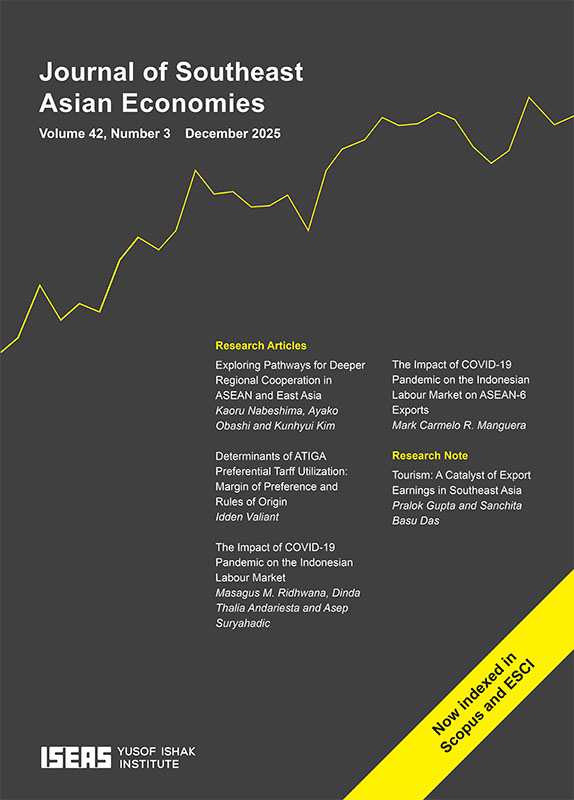
Journal of Southeast Asian Economies Vol. 42/3 (December 2025)
Date of publication:
December 2025
Publisher:
ISEAS – Yusof Ishak Institute
Number of pages:
99
Code:
AE42/3
Soft Cover
ISSN: 23395095

Contents
-
Journal of Southeast Asian Economies Vol. 42/3 (December 2025)
[Whole Publication, ISSN: 23395200] -
Preliminary pages
- RESEARCH ARTICLES
-
1. Exploring Pathways for Deeper Regional Cooperation in ASEAN and East Asia, by Kaoru Nabeshima, Ayako Obashi, Kunhyui Kim, authors see abstractRegulatory harmonization is increasingly recognized as a key component of deeper regional integration. However, identifying the optimal approach to regulatory harmonization remains a challenge. This paper proposes a metric to identify the optimal benchmark country for aligning national regulatory frameworks within a regional trade agreement. Using the United Nations Trade and Development’s (UNCTAD) non-tariff measures database, we develop a bilateral regulatory dissimilarity indicator to quantify regulatory differences between countries. We then identify the optimal benchmark country whose regulatory framework minimizes regulatory adoption costs for other members in the cases of regional integration efforts in Asia. When considering all merchandise, our findings indicate that Vietnam serves as the least costly, optimal benchmark for the AEC, while Australia is optimal for the CPTPP and RCEP. In comparison, using Cambodia or Malaysia as the benchmark incurs high regulatory adoption costs, suggesting the need for policy efforts by these countries. The study also highlights sectoral variations in regulatory differences. These findings offer valuable insights for policymakers seeking to advance regulatory harmonization and facilitate deeper integration.
-
2. Determinants of ATIGA Preferential Tariff Utilization: Margin of Preference and Rules of Origin, by Idden Valiant, author see abstractThe Association of Southeast Asian Nations (ASEAN) Trade in Goods Agreement (ATIGA), the flagship Free Trade Agreement (FTA) within the ASEAN region, demonstrates lower utilization rates compared with similar agreements in North America or the European Union. This study investigates the determinants influencing ATIGA’s utilization, focusing on the Margin of Preference (MOP) and the stringency of Rules of Origin (ROO) as critical factors. Using customs import data and tariff schedules across ASEAN Member States from 2010 to 2022, the analysis reveals that higher MOP values consistently promote utilization while stricter ROO requirements act as barriers. Sectoral analysis highlights significant variations: manufacturing sectors face greater challenges due to ROO complexity whereas agricultural sectors benefit from simpler requirements such as the Wholly Obtain criterion. Interestingly, some sectors, such as clothing and electrical machinery, show inverse relationships between MOP and utilization, indicating nuanced trade-offs in firms’ strategic decisions. While ATIGA utilization is not a direct proxy for trade liberalization, these findings offer actionable insights for policymakers aiming to optimize ATIGA uptake and enhance its policy effectiveness, particularly through targeted reforms to ROO and tailored sectoral strategies.
-
3. The Impact of COVID-19 Pandemic on the Indonesian Labour Market, by Masagus M. Ridhwan, Dinda Thalia Andariesta, Asep Suryahadi, authors see abstractThe COVID-19 pandemic caused severe economic contractions across sectors. We assess the impact of these sectoral GDP losses on workers’ labour market outcomes during the pandemic and recovery periods using Indonesian data. Using a robust difference-in-differences approach, we find that sectoral GDP losses caused significant decline in workers’ earnings, working hours, earnings per hour and formal sector employment. Conversely, they led to substantial increases in job search and employment in the informal sector. These impacts persisted into the recovery period, albeit with declining magnitudes. Furthermore, we find heterogeneous impacts with workers in rural areas, with male workers and young workers often experiencing more severe effects. These findings imply that social assistance must be maintained beyond the crisis and tailored to specific groups. Improving the labour market information system is also crucial to facilitate the transition to formal employment.
-
4. The Effects of European Union’s Carbon Border Adjustment Mechanism on ASEAN-6 Exports, by Mark Carmelo R. Manguera, author see abstractThe European Union’s (EU) Carbon Border Adjustment Mechanism (CBAM) represents a major shift in global trade and climate policy, disproportionately affecting developing countries. As the EU CBAM enters its transition period, the ASEAN-6 countries—Indonesia, Malaysia, the Philippines, Singapore, Thailand and Vietnam—face significant risks, given the absence or limited use of explicit carbon pricing instruments. Gravity model estimates reveal that the cement and iron and steel sectors are most sensitive to tariff adjustments. Projections of the EU CBAM’s carbon tariff equivalent indicate that the Philippines will experience the steepest export declines to the EU in these sectors, with reductions of 15 per cent for cement and 11.6 per cent for iron and steel. This is equivalent to annual losses of US$1 million and US$5.3 million respectively. Thailand, however, incurs the heaviest value loss in cement exports (US$1.5 million) because of its larger export base, showing how emission intensity and market size jointly shape any resulting impact. These findings highlight the widening regulatory gap between developed and developing economies, where countries with less stringent climate policies face mounting trade barriers. This underscores ASEAN’s urgent need to advance carbon pricing and transition towards lower-carbon production processes while leveraging the EU’s financing and technical support to aid a just transition towards a greener economy.
- RESEARCH NOTE
-
5. Tourism and Export Earnings in Southeast Asia, by Pralok Gupta, Sanchita Basu Das, authors see abstractTourism is a significant sector in many Southeast Asian economies, with tourism exports making up a high share of total services exports in countries such as Cambodia, Lao People’s Democratic Republic and Thailand. This article aims to improve understanding of the role international tourism plays in export earnings in Southeast Asia. The article explores the sector’s linkage to merchandise trade and examines multilateral, regional and unilateral policies to safeguard tourism services trade in the region. The article concludes that a 1 per cent in international tourist inflows to Southeast Asia is associated with a 0.62% increase in the region’s merchandise exports. Looking at services trade commitments for the tourism sector, the article finds that liberalization commitments under ASEAN’s own ASEAN Framework Agreement on Services are the most advanced. The countries did not go beyond their multilateral General Agreement on Trade in Services commitments under the megaregional Regional Comprehensive Economic Partnership. Further, as COVID-19 waned, the recovery of inbound tourism depended largely on countries’ unilateral policies to support the sector. That said, countries in Southeast Asia need to recognise the value of the linkage between inbound tourism and their merchandise exports, and develop unilateral and regional policies to serve their economic interests accordingly.