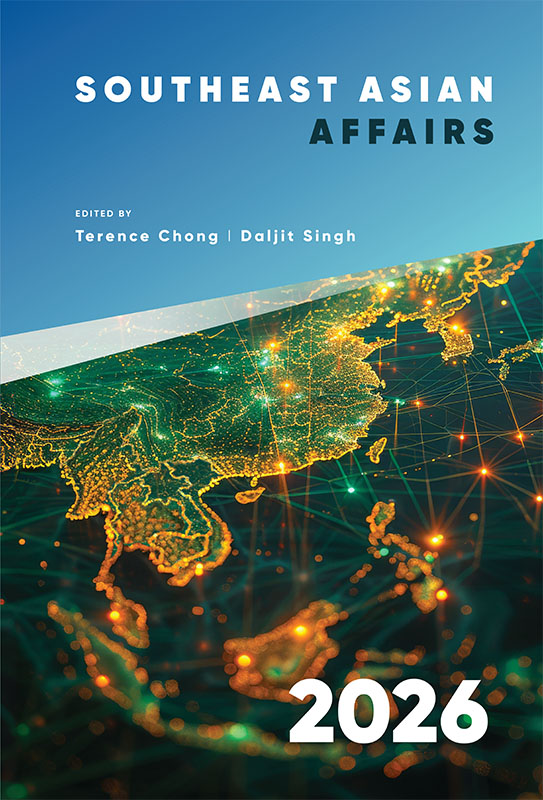
Southeast Asian Affairs 2026
Date of publication:
2026
Publisher:
ISEAS – Yusof Ishak Institute
Number of pages:
336
Code:
SEAA26
Hard Cover
ISBN: 9789815361001

About the publication
Southeast Asian Affairs, produced since 1974, is an annual review of significant trends and developments in the region. The emphasis is on ASEAN countries but important developments in the broader Asia-Pacific region are not ignored. The publication seeks to provide readable and easily understood analyses of major political, strategic, economic and social developments within the region.
Contents
-
Southeast Asian Affairs 2026
[Whole Publication, ISBN: 9789815361520], by Terence Chong, Daljit Singh, authors -
Preliminary pages with Introduction
- THE REGION
-
Acting Together and Alone: Southeast Asia’s Political and Security Landscape in 2025, by Graham Ong-Webb, author see abstractSoutheast Asia’s political and security landscape in 2025 was defined by a widening gap between the region’s ability to convene collectively and its ability to manage hard risks collectively. ASEAN remained central as a diplomatic platform and as the vehicle for incremental economic integration, yet consensus-based processes continued to limit decisive outcomes on the most divisive security challenges. This produced a familiar pattern: the region acted together for signalling, agenda-setting and institution-building, while individual governments increasingly acted alone, or in selective groupings, to manage immediate security and geoeconomic pressures. Externally, major-power competition sharpened. The United States adopted a more openly transactional approach to partnership, blending reassurance with demands for reciprocity and bargaining over market access, supply chains and security cooperation. China sustained a dual-track strategy of deepening economic engagement while applying coercive pressure in contested maritime spaces. Other extra-regional actors also expanded their strategic presence and partnerships, reinforcing a more crowded and competitive operating environment for Southeast Asian states. Domestically, governments across the region faced uneven political resilience and rising governance pressures. Electoral politics, elite contestation, institutional frictions and public expectations complicated policy delivery, while cost-of-living concerns and labour market sensitivities remained salient. These internal dynamics shaped how states interpreted external risks and constrained their room for manoeuvre, especially as the boundary between economics and security continued to blur. The chapter concludes that Southeast Asia’s strategic outlook is best understood through this duality of acting together and acting alone. ASEAN’s convening power remains valuable, and economic integration continues to advance at the margins, yet the region’s ability to collectively mitigate conflict risks and coercion remains limited. This imbalance is likely to persist into 2026, placing a premium on national resilience and adaptable diplomacy alongside ASEAN-centred engagement.
-
Southeast Asian Economies in 2025, by Cassey Lee, Peh Ko Hsu, authors see abstractThe Trump reciprocal tariffs dampened economic sentiments in the first half of 2025. The subsequent reduction in tariffs de-escalated global trade tensions. A number of countries—namely, Malaysia, Singapore and Vietnam—grew robustly because of strong export performance. Inflationary pressures also remerged across many Southeast Asian countries. The ongoing civil war in Myanmar and the Thailand-Cambodia border conflict weighed on these economies. The region also suffered severely from a series of natural disasters, such as the earthquake in Myanmar and climate-related typhoons and cyclones in Indonesia, Malaysia, the Philippines, Thailand and Vietnam.
- BRUNEI DARUSSALAM
-
Brunei Darussalam in 2025: Intensifying Efforts at Economic Diversification in the Last Decade of Wawasan 2035, by Jatswan S Sidhu, author see abstractIn 2025, Brunei recorded a lower level of economic growth than in 2024, largely attributable to heightened global economic uncertainties and a slowdown in the non-oil and gas segments of the economy. Meanwhile, Brunei entered its last decade of Wawasan 2035 (Vision 2035), which aims, among other things, to create a dynamic and sustainable economy beyond oil. Numerous initiatives were undertaken therefore in 2025 aimed at economic diversification in order to reduce the country’s dependence on the oil and gas sector. This chapter provides a broad overview of key political and economic developments in Brunei for 2025 and the challenges it faced alongside major foreign policy, security and defence issues.
- CAMBODIA
-
Cambodia in 2025: A Year of “Polycrisis” or Opportunity?, by David Hutt, author see abstractCambodia’s tumultuous year was less a turning point than a stress test of Prime Minister Hun Manet’s young regime. In many ways, the ruling Cambodian People’s Party turned interlocking shocks—a border war with Thailand, a mounting crackdown on scam centres, US tariffs, a remittance collapse, and slowing growth—into renewed political resilience and foreign policy openings, notably with Washington. Yet this crisis management further deepens structural vulnerabilities, entrenching an elite-centred scam economy and authoritarian rule whose costs will surface from 2026 onward.
-
The Scam Economy in Cambodia, by Jacob Sims, Bopha Phorn, authors see abstractCambodia’s rapidly expanding cyber-fraud industry has evolved from a peripheral criminal activity into a core pillar of the country’s political economy, reshaping assumptions about national governance, regional security and global financial integrity. According to a wide body of recent research, by 2025, the scam economy has become deeply enmeshed in Cambodia’s political economy, and particularly with a cadre of elite families and ruling-party-oriented patronage networks implicated in its growth. This chapter examines the scope of the industry, the conditions that facilitated its rapid expansion, and the nature of the state’s response thus far. While the Cambodian government has staged selective raids and entered into various international cooperation agreements, these have not addressed the entrenched structures of elite protection and profit-sharing that sustain the industry, a reality that emerges from a strong scholarly evidence base about the ruling party’s historic relationship with illicit sectors. Emerging from this permissive environment, persistence of scam centres carries far-reaching consequences: domestically, they further corrode the rule of law and entrench human rights abuses; regionally, they destabilize neighbours through trafficking flows and cross-border criminal networks; and globally, they expose citizens from around the world to severe and escalating financial risk. The analysis suggests that, given the regime’s history of cultivating illicit markets and their present profound dependence on scam-related rents, meaningful reform is unlikely. As a result, viable international responses are increasingly being framed in terms of containment and mitigation rather than near/mid-term expectations of systemic change within Cambodia.
- INDONESIA
-
Indonesia in 2025: Politics, the Economy and Foreign Policy Under the Prabowo Government, by Julia Lau Min Li, Maria Monica Wihardja, authors see abstractPrabowo Subianto’s first year as president has seen challenges in the realms of domestic politics, economics, geopolitics and geoeconomics. His administration’s ability to fulfil its ambitious policy agenda remains questionable, even if some positive developments have taken place.
-
Ratcheting Up Repression, by Muhammad Fajar, Sabella Clara Yandinata, authors see abstractDuring Prabowo’s first year in office, his administration increasingly relied on repression rather than accommodating opposition groups, as evidenced by the Dark Indonesia protests and the protests against legislators’ perks, with the latter resulting in higher casualties because of state violence. This pattern reflects the breadth of support Prabowo has consolidated, enabling him to exercise coercive power with minimal restraint, and highlights the institutional foundations built during Joko Widodo’s tenure that have facilitated such actions. At the same time, the growing readiness of the administration to suppress public dissent signals a clear warning to opposition groups that his administration has become bolder in employing repression towards public grievances. Together, these trends have accelerated Indonesia’s democratic backsliding and widened the pathway towards an authoritarian regime.
- LAOS
-
Laos in 2025: The Art of Muddling Through, by Nick J Freeman, author see abstractHaving relinquished chairmanship of ASEAN at the end of 2024, the Lao leadership was able to focus on domestic matters in 2025, ahead of the fiftieth anniversary of the Lao People’s Democratic Republic’s (LPDR) founding in December 2025 and the 12th national congress of the Lao People’s Revolutionary Party (LPRP), due in early 2026. This included making revisions to the constitution, formulating the next five-year socio-economic development plan, streamlining of ministry portfolios, as well as implementing changes to local government structures. Laos needs to prepare for graduation from the status of a less-developed country, currently scheduled for November 2026, which has ramifications for the terms and scale of donor support. Notwithstanding some positive progress in recent years, the government has yet to commit to the kind of emphatic economic policy programme that would place the country on a more resilient, sustainable and vibrant footing. Regrettably, “muddling through” remains Laos’ default policy settin
- MALAYSIA
-
Malaysia in 2025: Consolidation at Home, Expansive Diplomacy Abroad, by Kai Ostwald, author see abstractMalaysia combined cautious political consolidation at home with unusually active diplomacy abroad in 2025. The absence of major challenges to the Unity Government’s survival shifted focus to more “normal” politics, though progress on Anwar Ibrahim’s reform agenda remained modest, constrained by intra-coalition bargaining and polarized identity politics. Control over Malay-Muslim narratives continued to tilt towards the opposition party PAS, while sharpening East Malaysian demands over MA63 and the results of Sabah’s state election underscored a more contested federal balance. Headline economic growth numbers were solid despite tariff shocks and global uncertainty, but persistent cost-of-living pressures complicated politically sensitive petrol subsidy rationalization and tax reforms. Malaysia was highly visible as ASEAN chair, hosting major state visits and overseeing the completion of regional economic initiatives, while also mediating the Thai-Cambodian border crisis and recalibrating engagement with Myanmar. The year demonstrated both the possibilities and limits of Malaysia’s active middle-power strategy amid domestic contestation and intensifying great power rivalry.
-
Malaysia as ASEAN Chair: Achievements and Long-Term Challenges, by Johan Saravanamuttu, author see abstractMalaysia’s chairmanship of ASEAN in 2025 carried symbolic significance, marking the tenth anniversary of the ASEAN Community, which was launched during its 2015 tenure. Under the theme “Inclusivity and Sustainability”, Malaysia sought to reinforce ASEAN centrality, deepen economic integration, and advance digital transformation and community building. Key milestones included the ASEAN Foreign Ministers’ Retreat in Langkawi and the launch of the ASEAN Infrastructure Plan 2025–2028. By the 47th ASEAN Summit held at the end of October, the two most noteworthy achievements were the Kuala Lumpur Peace Accord—the mediation of peace between Thailand and Cambodia—and the accession of Timor-Leste as the eleventh member of ASEAN, the latter considered to be a milestone of ASEAN’s inclusivity. The conflict in Myanmar continued to simmer despite assertions of diminished violence, with little to no progress made on ASEAN’s Five-Point Consensus (5PC). It remains ASEAN’s most difficult and debilitating internal problem. Progress on the contentious issue of the South China Sea remained limited. Economic highlights included upgrading the ASEAN-China Free Trade Agreement and managing US tariff pressures, the convening of the inaugural ASEAN-Gulf Cooperation Council–China Summit, and the fifth Regional Comprehensive Economic Partnership (RCEP) Summit. Malaysia’s pragmatic approach emphasized stability and inclusivity, while persistent regional challenges—particularly Myanmar—underscore ASEAN’s ongoing struggle to maintain cohesion and relevance.
- MYANMAR
-
Myanmar in 2025: China Backs Junta to Consolidate Power Under the Cover of Potemkin Elections, by Morten B Pedersen, author see abstractThe year 2025 saw a change in momentum in Myanmar’s civil war as the Myanmar armed forces recaptured several key towns and reopened major trade routes. The 2025 elections were widely dismissed as a “sham”, intended simply to manufacture legitimacy for continued military rule in a different guise, but they paved the way for the military junta to transition to a nominally civilian administration in 2026, led by its proxy-party, the Union Solidarity and Development Party. The resistance forces remained in control of large parts of the country, including most of the country’s international borders, and they are intent on continuing their struggle to overthrow military rule. However, with China now openly backing the junta, their odds of defeating the military regime have lengthened. Meanwhile, Beijing was pushing for major Chinese economic projects to resume, including the Mandalay–Muse railway, the Kyaukphyu deep-sea port, and the Myitsone Dam.
-
Patchwork Humanitarian Governance in a Fragmented State: Aid, Disaster and Local Communities in 2025 Myanmar, by Su Mon Thazin Aung, Moe Thuzar, authors see abstractAmid rising conflict and territorial contestation between armed actors, Myanmar experienced two major shocks in 2025—the abrupt withdrawal of US humanitarian assistance and a devastating earthquake in central Myanmar. This chapter examines humanitarian governance in post-coup Myanmar through two major research questions: how sudden external shocks reshape the humanitarian governance landscape across territories, and how humanitarian spaces are utilized by different actors to reinforce their own political aims. This chapter highlights that, in the absence of a cohesive national humanitarian system, multiple actors manage relief operations within their own territories, resulting in uneven, unstable outcomes. When confronted with external shocks, these actors respond according to their own capacities and priorities, though their efforts are rarely complementary or well-aligned. Each actor operates under distinct political, resource and territorial constraints. The main burden of humanitarian response has fallen on local communities, which are already deeply affected by the ongoing conflicts. The patchwork humanitarian governance in Myanmar is not an accidental outcome. Over more seventy years of civil war, unresolved disputes over legitimacy, and the political instrumentalization of aid during external shocks have all contributed to this outcome. Without a cross-territorial political settlement, humanitarian governance in Myanmar is likely to remain fragmented, reactive and structured in ways that place unequal burdens on affected communities.
- THE PHILIPPINES
-
The Philippines in 2025:Scandals, Accountability and Resilience, by Jan Robert R Go, author see abstractThe year 2025 marked a pivotal moment in Philippine democracy, exposing the tension between institutional resilience and systemic weakness. This chapter explores key political crises, including the arrest of former President Rodrigo Duterte, the failed impeachment of Vice President Sara Duterte, the scandals involving flood control and infrastructure, and the May midterm elections, to demonstrate how formal procedures and accountability mechanisms were exploited for factional gain. These events highlighted the persistence of dynastic dominance, patronage networks and selective enforcement of rules, while also sparking a modest revival of civil society, exemplified by the 21 September protests commemorating martial law. The chapter contends that 2025 exemplifies “crisis endurance”: the ability of political institutions to withstand scandal, elite division and public discontent without implementing meaningful reform. Placing the Philippines within a wider Southeast Asian context, it shows how resilience is maintained through procedural legitimacy, elite negotiation and public resignation. Ultimately, the events of the year underscore the potential for civic engagement to restore moral and political significance even under limited conditions.
-
A Tale of Two Houses: The Unravelling of the Marcos-Duterte Dynastic Alliance and the Implications for the Philippines, by Maria Ela L Atienza, author see abstractThis chapter traces the formation and subsequent disintegration of the dynastic alliance between the Marcos and the Duterte families, from its consolidation during the 2022 presidential elections to its rapid unravelling into the current bitter political wars today. It examines the developments that contributed to the widening fissures between the two families, including the impeachment of Vice President Sara Duterte, the arrest of former President Rodrigo Duterte for crimes against humanity, the midterm elections, the Supreme Court’s declaration of the unconstitutionality of the impeachment, and the current corruption probes, while also evaluating the broader political consequences of this rivalry in the Philippines.
- SINGAPORE
-
Singapore in 2025: SG60 Milestone, Political Consolidation, Economic Resilience, and Maintaining the Social Compact, by Alwyn Lim, author see abstractSingapore in 2025 was defined by its SG60 jubilee commemoration, reflecting on six decades of independence in the context of current global volatilities. In his inaugural year, Prime Minister Lawrence Wong secured a resounding electoral mandate for the People’s Action Party, moving ahead with consolidating his governing approach of managed pluralism. Economic growth was resilient, especially in manufacturing and tourism, though inflation and labour pressures were a concern. These concerns were addressed through the government’s Budget 2025, which focused on sustainability and skills. Socially, low fertility and an ageing population remained a focal issue and prompted the government to expand family incentives and eldercare expansions, while Singapore’s multicultural framework was tested by tensions like the Israel-Palestine conflict. In the area of diplomacy, Singapore emphasized regional unity during the 47th ASEAN Summit, while also strengthening bilateral ties with India, the United States and China. Overall, the global uncertainty of 2025 tested Singapore’s pragmatic model but affirmed its adaptability and openness for the future.
-
Singapore’s 2025 General Election: A Mandate for the New Prime Minister, by Elvin Ong, author see abstractThe long dominant ruling party of Singapore, the People’s Action Party (PAP), won another electoral victory in Singapore’s 2025 general elections. The PAP returned to power with 87 out of 97 parliamentary seats on offer, with a 65.6 per cent vote share, continuing its uninterrupted history of electoral victories in every general election since Singapore’s independence in 1965. The remaining 10 seats were won by the main opposition party, the Workers’ Party (WP). Key issues on the campaign trail included global political and economic uncertainty, the cost of living, foreign interference in domestic politics, and the relevance of race and religion to electoral politics. Podcasts emerged as one of the most significant new forms of political communication during this election.
- THAILAND
-
Thailand in 2025: Intertwined Crises Within and Without, by Mathis Lohatepanont, author see abstractIn 2025, both domestic and geopolitical turbulence contributed to a major realignment of Thailand’s governing arrangements. The collapse of the power-sharing agreement between the Pheu Thai Party and the Bhumjaithai Party, fuelled by cabinet reshuffling and the leak of an incendiary voice call between Prime Minister Paetongtarn Shinawatra and Cambodia, resulted in the end of Shinawatra rule. An unexpected compromise between the conservative Bhumjaithai and the progressive People’s Party led to a confidence and supply agreement, allowing Bhumjaithai leader Anutin Charnvirakul to lead a new minority government. This arrangement proved unstable and culminated in a dissolution of parliament in December, paving the way for fresh elections in 2026. All of this took place against a backdrop of conflict with Cambodia, an uncertain international economic environment, and an economy that continues to stubbornly lag behind its peers.
-
The 2025 Thailand-Cambodia Border Crisis: Nationalism and Limit of Military Approach, by Puangthong R Pawakapan, author see abstractThe 2025 Thailand-Cambodia border crisis represents a significant regression in bilateral relations, driven by a volatile mix of long-standing historical grievances and contemporary domestic politics. While economic interdependence initially promised stability, the relationship collapsed as a result of the politicization of ultra-nationalism and unresolved colonial-era territorial claims. The conflict was intensified by the breakdown of the relationship between the Shinawatra and Hun families that undermined the legitimacy of Thai Prime Minister Paetongtarn Shinawatra. The fragility of Thailand’s civilian government allowed the military to assume a leading role in the conflict, prioritizing national security over economic interests. Digital platforms became “battlegrounds” where social media influencers and nationalist groups amplified misinformation and hatred, effectively overriding rational policymaking and hindering diplomatic compromise. International mediation remained ineffective because of Thailand’s deep-seated distrust of third-party intervention.
- TIMOR-LESTE
-
Timor-Leste in 2025: ASEAN Accession amid Domestic Challenges, by Michael Leach, author see abstractIn the year Timor-Leste celebrates the fiftieth anniversary of its first declaration of independence in 1975, and the twenty-third anniversary of its restoration, the country finally achieved one of its longest-held foreign policy ambitions—gaining admission to the ASEAN regional political and economic grouping in October 2025. At the helm to guide Timor-Leste through this major transition to regional integration were the “old firm” of independence leaders, José Ramos-Horta and Xanana Gusmão, who presided over significant foreign policy successes but still grappled with pressing domestic issues. In 2025, these included new challenges of organized crime, youth protests, and continuing negotiations over the future management of Timor-Leste’s oil and gas reserves. Many of these policy challenges arose from a major demographic “youth bulge” and the continuing need to diversify the country’s economy and reduce excessive dependence on the oil and gas sector.
- VIETNAM
-
Vietnam in 2025 Dawn of the “Era of National Rise”?, by Le Hong Hiep, author see abstractIn 2025, Vietnam underwent significant political and economic transformations, all aimed at entering a new “era of national rise”. Politically, bureaucratic streamlining and provincial mergers were key highlights, while preparations for the CPV’s 14th National Congress dominated the political calendar. Economically, Vietnam implemented aggressive reforms and massive infrastructure development to achieve an 8 per cent GDP growth rate, but it faced significant challenges from rising housing prices, a weakened currency and US “reciprocal” tariffs. In terms of foreign policy, Vietnam reinforced its longstanding principles of independence, self-reliance, diversification and multilateralization, while adeptly navigating the escalating US-China rivalry. This chapter reviews the achievements and shortcomings of Vietnam’s key political, economic and foreign policy initiatives in 2025 and assesses the opportunities and challenges the CPV encountered along the way. It argues that although 2025 displayed encouraging momentum, whether Vietnam truly enters the promised “era of national rise” will depend not on the short-term policy measures introduced this year but on the clarity, consistency and sustainability of its long-term strategy.
-
US-Vietnam Relations and a New Era in World Politics, by Alexander Vuving, author see abstractThe rise of China and the growth of US-China competition are shifting Vietnam back to the centre stage of world politics and making US-Vietnam relations a critical element of Indo-Pacific geopolitics. This chapter discusses the main dynamics of US-Vietnam relations. To this end, it examines the evolution of Vietnamese-American ties, identifies the underlying power structure of the world and the Indo-Pacific region, and analyses the implications of Chinese and American grand strategies for Vietnam and US-Vietnam ties. These analyses suggest that the Sino-US rivalry and Vietnam’s quest for its place in the world are the primary drivers of Vietnamese-American relations. As a result of these dynamics, Vietnam can be a quasi-ally of the United States, a swing state between the great powers, or a torn country in their rivalry.