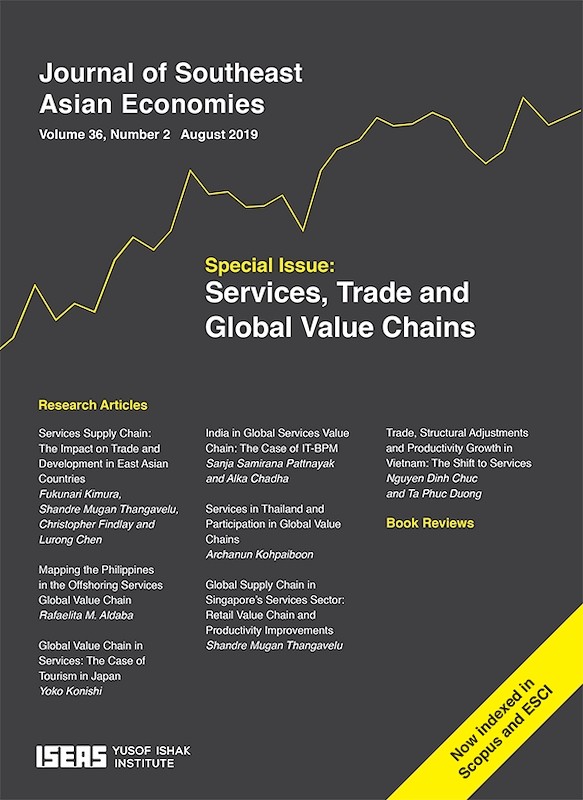
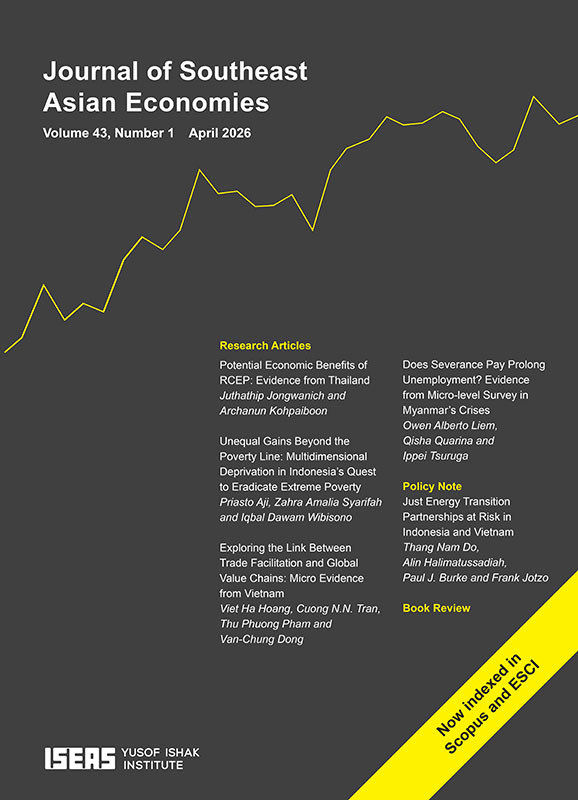
Journal of Southeast Asian Economies Vol. 43/1 (April 2026)
Date of publication:
April 2026
Publisher:
ISEAS – Yusof Ishak Institute
Number of pages:
113
Code:
AE43/1
Soft Cover
ISSN: 23395095

Contents
-
Journal of Southeast Asian Economies Vol. 43/1 (April 2026)
[Whole Publication, ISSN: 23395200] -
Preliminary Pages
- RESEARCH ARTICLES
-
Potential Economic Benefits of RCEP: Evidence from Thailand, by Juthathip Jongwanich, Archanun Kohpaiboon, authors see abstractThis paper undertakes a narrative analysis of the Regional Comprehensive Economic Partnership (RCEP) and its economic use for small developing countries using Thailand as the case study. The key finding is that while RCEP so far has been the world’s largest mega FTA, the agreement did not directly strengthen the economic ties between Thailand and the RCEP members due to the weak commitment to trade and investment liberalization. This is in line with the limited use of the RCEP preferential schemes illustrated in the analysis of the administrative records of Thailand’s RCEP preferential schemes in 2022 and 2023. The product items that applied for the preferential scheme were highly concentrated, varied across its members, and unlikely to be induced by the cumulative rules of origin among RCEP members. Nonetheless, the RCEP agreement helps create a more predictable and conducive economic environment, thereby encouraging foreign direct investment (FDI) inflows into and outflows from Thailand. The true potential economic benefit of RCEP would be derived from its rule-based institutional feature that could mitigate economic uncertainty that has been immensely escalated recently.
-
Unequal Gains Beyond the Poverty Line: Multidimensional Deprivation in Indonesia’s Quest to Eradicate Extreme Poverty, by Priasto Aji, Zahra Amalia Syarifah, Iqbal Dawam Wibisono, authors see abstractDespite falling monetary poverty rates, Indonesia is facing persistent multidimensional deprivation, especially among the extreme poor. This paper assesses poverty reduction progress through a multidimensional lens, using the Alkire-Foster (A-F) method to analyze deprivations in health, education, living standards, basic needs and social participation. Drawing on nationally representative data from 2019, 2022 and 2024, we compare A-F scores across extreme poor, poor and non-poor groups, disaggregated by gender, location and region. Although Indonesia’s extreme poverty rate reached 0.83 per cent by March 2024, about one-third of them remain deprived, particularly in sanitation, adequate living space and digital access. Geographically disaggregated data show variation in deprivation patterns by region. These unequal gains highlight the persistence of non-monetary deprivation despite headline poverty alleviation progress. The findings underscore the value of multidimensional diagnostics in guiding policy responses aligned with both the 2026 target and Indonesia’s Vision 2045.
-
Exploring the Link Between Trade Facilitation and Global Value Chains: Micro Evidence from Vietnam, by Viet Ha Hoang, Cuong N.N. Tran, Thu Phuong Pham, Van-Chung Dong, authors see abstractUsing the World Bank Enterprise Survey between 2005 and 2023, covering 4,227 Vietnamese companies, this study examines the impact of trade facilitation on companies’ participation in global value chains (GVCs). The empirical findings show that trade facilitation significantly enhances the probabilities of Vietnamese companies’ GVC participation. In addition, larger, older and foreign-owned companies are more likely to integrate into GVCs. Meanwhile, no empirical evidence is observed regarding the effect of labour productivity on companies’ GVC participation. Our key findings remain robust across alternative measurements and different estimation approaches. We also observe heterogeneous effects across company sizes and ownership structures. Based on these insights, we provide several policy recommendations to encourage Vietnamese companies to participate more actively in GVCs.
-
Does Severance Pay Prolong Unemployment? Evidence from Micro-level Survey in Myanmar’s Crises, by Owen Alberto Liem, Qisha Quarina, Ippei Tsuruga, authors see abstractThis study examines the impact of severance payments on unemployment duration and reemployment quality in Myanmar’s labour market, using data from an ILO survey conducted in May–June 2022. The analysis accounts for the long-term effects of Covid-19 and the February 2021 military takeover. Cox regression and Kaplan-Meier survival curves show that severance payments are significantly associated with longer unemployment duration. A multinomial logit analysis finds that women and rural workers are less likely to secure reemployment, while higher education and salary are linked to longer unemployment, likely due to greater selectivity and higher reservation wages. Compliance with severance payment provisions is low, with less than 40 per cent of entitled workers receiving full payments, and women disproportionately affected. The military takeover placed a greater burden on women by increasing terminations in female-dominated government sectors including education and social services, compelling many to lower their reservation wages. Additional Cox regressions restricted to reemployed individuals confirm the robustness of the severance effect. While severance provides a financial buffer, it may also prolong unemployment among vulnerable groups. Policy recommendations include targeted job search assistance, retraining and employment programmes for women and rural workers. The external validity of these findings is limited by the exceptional context of the Covid-19 pandemic and the military takeover.
- POLICY NOTE
-
Just Energy Transition Partnerships at Risk in Indonesia and Vietnam, by Thang Nam Do, Alin Halimatussadiah, Paul J. Burke, Frank Jotzo, authors see abstractReducing global greenhouse gas emissions to net zero is a major challenge, particularly in coal-dependent emerging economies. Just Energy Transition Partnerships (JETPs) have been promoted as a novel mechanism to accelerate coal phase down. Yet, implementation has stalled despite strong political commitments. Drawing on 30 stakeholder interviews with government, civil society and international organizations in Indonesia and Vietnam, this policy note examines why JETP implementation has stalled. We identify a core misalignment between recipient country expectations for early concessional finance and international partners’ emphasis on reform conditionality. Low grant shares, slow disbursement and weakened trust—exacerbated by recent geopolitical shifts, including the withdrawal of the United States from JETPs in 2025—have further constrained progress. We argue that re-energizing JETPs requires an explicit sequencing strategy that front loads concessional finance and prioritizes politically and economically feasible pioneer projects delivering clear emissions reductions and development co-benefits. Such an approach can rebuild confidence, enable risk sharing and create conditions for boosting energy transition.
- BOOK REVIEW
-
Bangkok Transformed: An Economic History, 1820–1950, by Porphant Ouyyanont, NUS Press, 2025, by Yot Amornkitvikai, author see abstractThe author, Professor Porphant Ouyyanont was an eminent economic historian who passed away unexpectedly on 12 July 2020. The book was published posthumously with the editorial assistance of Chris Baker. Together, they have ensured that Bangkok’s history is not lost to time but preserved as a blueprint to understand the future. Unlike most other historical books on Thailand, this one offers an evidence-based account of how Bangkok became a regional hub between 1820 and 1950.