SOJOURN: Journal of Social Issues in Southeast Asia Vol. 40/3 (November 2025)
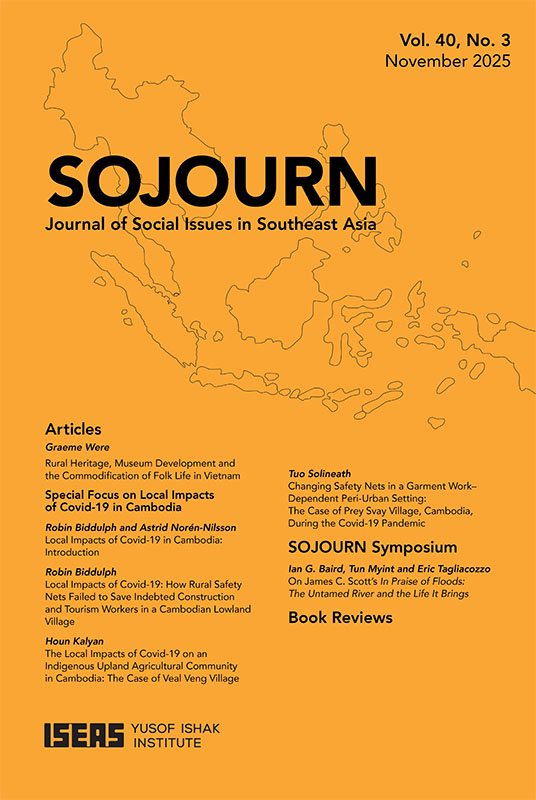
Date of publication:
October 2025
Publisher:
ISEAS – Yusof Ishak Institute
Number of pages:
155
Code:
SJ40/3
Soft Cover
ISSN: 02179520

Contents
-
SOJOURN: Journal of Social Issues in Southeast Asia Vol. 40/3 (November 2025)
[Whole Publication, ISSN: 17932858] -
Preliminary pages
- ARTICLES
-
Rural Heritage, Museum Development and the Commodification of Folk Life in Vietnam, by Graeme Were, author see abstractThis article addresses the growth of heritage tourism in rural Vietnam. Focusing on agricultural tourism in close vicinity to a UNESCO World Heritage site, it examines the competing visions of the local community, government bureaucrats and international agencies in the development of a rural museum. It shows that what is at stake is not just sensitivities over representations of folk life but also control over the structures to effectively generate profit. The article argues that the museum can be understood as an integral component in the commodification of the rural landscape rather than a tool necessary for nation-building or cultural preservation.
- SPECIAL FOCUS ON LOCAL IMPACTS OF COVID-19 IN CAMBODIA
-
Introduction: Local Impacts of Covid-19 in Cambodia, by Robin Biddulph, Astrid Norén-Nilsson, authors
-
Local Impacts of Covid-19: How Rural Safety Nets Failed to Save Indebted Construction and Tourism Workers in a Cambodian Lowland Village, by Robin Biddulph, author see abstractThis article examines the local impacts of the Covid-19 pandemic on the “more than rural” livelihoods of a lowland rice farming village in Cambodia. We found that poorer households mainly dependent on local natural resources and farming were only slightly affected by the pandemic and required few coping strategies. Households with higher incomes, especially from tourism and construction, were more vulnerable, especially because many were burdened with debt, including some who ultimately fled their homes and the village to escape creditors. We argue that the economic shock of the pandemic exposed underlying issues of over-indebtedness, which seem widespread in rural Cambodian society.
-
The Local Impacts of Covid-19 on an Indigenous Upland Agricultural Community in Cambodia: The Case of Veal Veng Village, by Houn Kalyan, author see abstractThis article explores the local impacts of Covid-19 on an upland agricultural community in Cambodia, emphasizing how household resilience was influenced by land ownership, livestock assets and financial resources—aspects often overlooked in studies of the effects of a pandemic on indigenous communities. Based on research conducted between November 2023 and January 2025 in an indigenous Kuy village, it was found that households with stronger asset bases demonstrated greater capacity to cope with the economic fallout of Covid-19. It is argued that the pandemic reinforced long-standing patterns of land concentration and increasing income inequality in ways that intersect with the legal and political marginality of indigenous communities in Cambodia’s upland region.
-
Changing Safety Nets in a Garment Work–Dependent Peri-Urban Setting: The Case of Prey Svay Village, Cambodia, during the Covid-19 Pandemic, by Tuo Solineath, author see abstractThis article explores how the Covid-19 pandemic affected the livelihood activities of residents of a peri-urban village in Cambodia with high dependence on garment factory and construction work. Livelihood scholarship generally identifies diversity as key to resilience, with traditional rural livelihood activities seen as a potential safety net in view of the challenges posed by urbanization. In Prey Svay, contrary to early studies of the pandemic, garment factory work was barely disrupted and served as a source of resilience. By examining how Prey Svay’s residents navigated the disruption wrought by the pandemic, this article contributes insights into how informal safety nets and gender and generational factors inform economic resilience in the context of broader debates on rural-to-urban livelihood transitions, labour precarity and agrarian change in Southeast Asia.
- SOJOURN SYMPOSIUM
-
On In Praise of Floods: The Untamed River and the Life It Brings by James C. Scott, by Ian G Baird, Tun Myint, Eric Tagliacozzo, authors
- BOOK REVIEWS
-
BOOK REVIEW: Stalemate: Autonomy and Insurgency on the China-Myanmar Border by Andrew Ong, by Moe Thuzar, author
-
BOOK REVIEW: Rights Refused: Grassroots Activism and State Violence in Myanmar by Elliott Prasse-Freeman, by Jae Hyun Park, author
-
BOOK REVIEW: The Drama of Dictatorship: Martial Law and the Communist Parties of the Philippines by Joseph Scalice, by Karlo Mikhail I Mongaya, author
-
BOOK REVIEW: Indigenizing the Cold War: The Border Patrol Police and Nation-Building in Thailand by Sinae Hyun, by Paul Chambers, author
-
BOOK REVIEW: Chiang Mai Between Empire and Modern Thailand: A City in the Colonial Margins by Taylor M. Easum, by Piyadech Arkarapotiwong, author
-
BOOK REVIEW: Between War and the State: Civil Society in South Vietnam, 1954–1975 by Van Nguyen-Marshall, by Johnathan L Tran, author
-
BOOK REVIEW: Subjects and Sojourners: A History of Indochinese in France by Charles Keith, by Uyen Nguyen, author
-
BOOK REVIEW: Traditional Musical Instruments of Malaysia: Forms, Materials, Function by Patricia Matusky, by Tazul Tajuddin, author