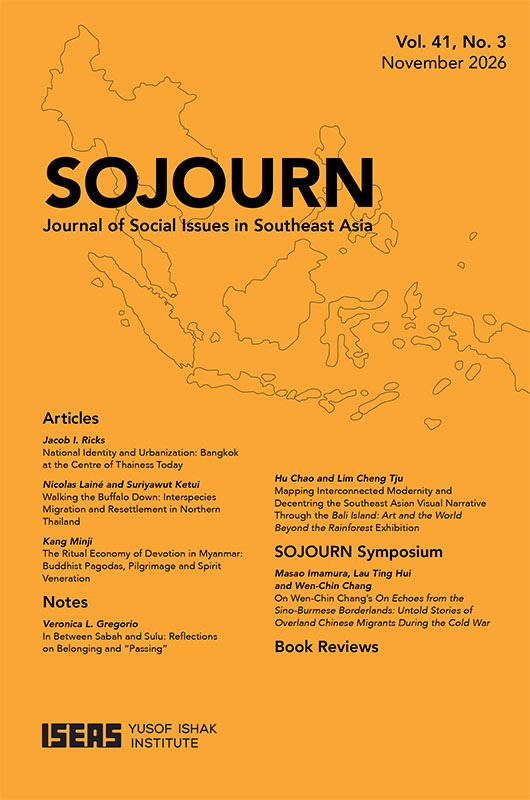
SOJOURN: Journal of Social Issues in Southeast Asia Vol. 41/3 (November 2026)
Date of publication:
November 2026
Publisher:
ISEAS – Yusof Ishak Institute
Number of pages:
155
Code:
SJ41/3

Contents
-
SOJOURN: Journal of Social Issues in Southeast Asia Vol. 41/3 (November 2026)
[Whole Publication, ISSN: 17932858] -
Preliminary pages
- ARTICLES
-
National Identity and Urbanization: Bangkok at the Centre of Thainess Today, by Jacob I Ricks, author see abstractThailand’s nation-building project was initiated and implemented through a top-down process by elites in Bangkok, with a significant narrative focus on idealizing rural peasants as largely passive recipients of state interventions. Today, though, the Thai population is predominantly urban, better educated, linked to global information flows and politically assertive. What becomes of Thai nationalism when the society it was designed to govern no longer exists? Drawing on survey data, I demonstrate that nationalism levels have begun to decline in urban areas. I argue that urban contestations in Bangkok are central to debates over the future of Thai nationalism.
-
Walking the Buffalo Down: Interspecies Migration and Resettlement in Northern Thailand, by Nicolas Lainé, Suriyawut Ketui, authors see abstractThis article examines Lua migration from the northern Nan uplands to the lowlands of Nan, northern Thailand, as an interspecies process shaped by movements that did not occur at the same time. Based on our ethnographic fieldwork and oral histories in Ban Huai Phan and surrounding settlements, the article reconstructs how wartime evacuation, animal displacement, herd recovery and village formation unfolded across different temporalities from the early 1970s onwards. People could be evacuated within hours, sometimes by military helicopter, while buffalo remained in the mountains for weeks, months or years before being retrieved, purchased, rebuilt into herds or eventually walked down. Following these uneven trajectories shows how lowland settlement emerged gradually as people, buffalo, land, labour and relations of care were brought into workable proximity. Buffalo restored forms of living and reproductive wealth and, as irrigated rice cultivation developed, acquired new importance in agricultural labour, while some ritual relations remained attached to upland places or were recomposed after displacement. Rather than treating migration as a human departure followed by arrival, the article approaches resettlement as an incomplete and extended process in which humans, animals, material resources and ritual obligations had different capacities to move and converge.
-
The Ritual Economy of Devotion in Myanmar: Buddhist Pagodas, Pilgrimage and Spirit Veneration, by Kang Minji, author see abstractThis article examines the contemporary transformation of spirit veneration within major Buddhist pagoda spaces in urban Myanmar. Rather than treating spirits as external to Buddhism or as evidence of simple ritual entanglement, it analyses how particular spirit figures are embedded within pagoda-centred devotional economies and respond to specific forms of everyday anxiety. Drawing on ethnographic cases such as Mya Nan Nwe, Sule Bobogyi, the Aba Yekha brothers and Lokapala Yekha Medawkyi, the study demonstrates how spirit figures operate as spiritual brokers for concerns surrounding overseas migration, employment, education, marriage, commercial success and financial survival. The article argues that post-2011 liberalization, expanding digital financial infrastructures and the intensified sense of precarity following the 2021 coup have accelerated a prosperity-oriented ritual economy in which offerings, pilgrimage, rumours of efficacy and mobile payments mutually reconfigure pagoda-based devotion.
- NOTES
-
In Between Sabah and Sulu: Reflections on Belonging and “Passing”, by Veronica L Gregorio, author see abstractThis research note examines how undocumented Filipino migrants in Lahad Datu, Sabah, navigate belonging, legality and visibility through everyday acts of passing and disclosure. Drawing on ethnographic encounters, it shows how migrants manage recognition, at times allowing themselves to be read as local and at others asserting difference through language, gesture or sound. It argues that these migrants engage in “relational passing”, a form of selective visibility through which they sustain kinship and dignity under conditions of illegality. Rather than deception, passing is a practice of survival grounded in local hierarchies of citizenship and kinship. Passing and cultural intimacy, the note further shows, operate as complementary strategies—the former enacted before the state and its proxies, the latter cultivated among co-ethnics in moments of shared recognition. Together, these practices reveal that belonging in maritime Southeast Asia is negotiated primarily through kinship and community ties, exceeding the boundaries of formal citizenship.
-
Mapping Interconnected Modernity and Decentring the Southeast Asian Visual Narrative Through the Bali Island: Art and the World Beyond the Rainforest Exhibition, by Hu Chao, Lim Cheng Tju, authors
- SOJOURN SYMPOSIUM
-
On Echoes from the Sino-Burmese Borderlands: Untold Stories of Overland Chinese Migrants During the Cold War by Wen-Chin Chang, by Masao Imamura, Lau Ting Hui, Wen-Chin Chang, authors
- BOOK REVIEWS
-
BOOK REVIEW: Rice Politics in Southeast Asia: Legacies of the Green Revolution by Jamie S. Davidson, by Anne Booth, author
-
BOOK REVIEW: Ruling Indonesia: Jokowi’s Presidency in an Age of Democratic Crisis and Great Power Competition by Marcus Mietzner, by Ian Wilson, author
-
BOOK REVIEW: Domestic Nationalism: Muslim Women, Health, and Modernity in Indonesia by Chiara Formichi, by Irna Nurlina Masron, author
-
BOOK REVIEW: Balikbayan: A Revenant History of the Filipino Homeland by Adrian De Leon, by Yasmin Ortiga, author
-
BOOK REVIEW: Deeper Ground, Darker Shadows: The Making of a Mindanao Rebel by Eddie L. Quitoriano, by Karlo Mikhail I Mongaya, author
-
BOOK REVIEW: Small Revolutionaries: Participation of Children and Youth in the Vietnam War by Mai Anh Nguyen, by George Dutton, author
-
BOOK REVIEW: The Everyday Politics of Resources: Lives and Landscapes in Northwest Vietnam by Nga Dao, by Sarah Grant, author