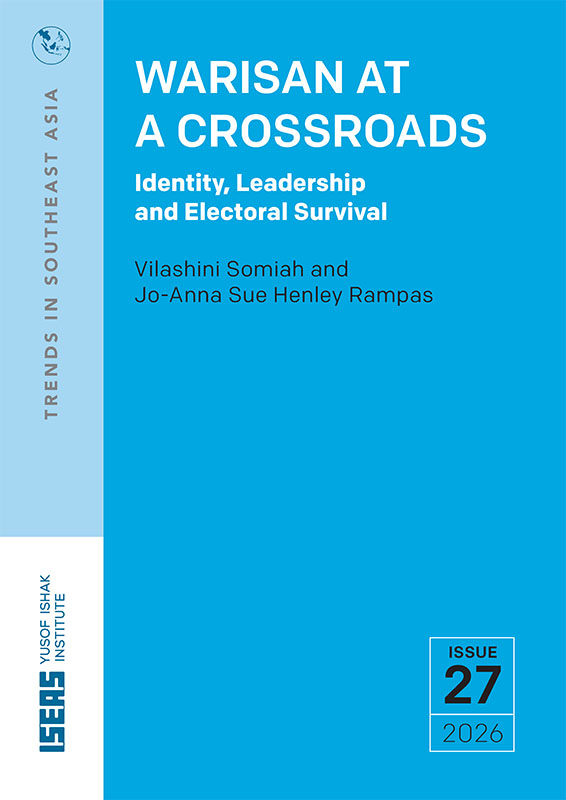
Warisan at a Crossroads: Identity, Leadership and Electoral Survival
Date of publication:
2026
Publisher:
ISEAS – Yusof Ishak Institute
Number of pages:
35
Code:
TRS27/26
Soft Cover
ISBN: 9789815393019

About the publication
- Parti Warisan (Warisan) is a Sabah-based multiracial party led by Shafie Apdal and built around a Sabah-first platform centred on autonomy and dignity and on Malaysia Agreement 1963 (MA63) claims. In the 2025 Sabah state election, it won 25 of 73 seats and won the popular vote.
- The 2025 Sabah state election confirmed the rise of a competitive local-party arena: Gagasan Rakyat Sabah (GRS) and Warisan together won 54 of 73 seats, while federal parties Barisan Nasional (BN) and Pakatan Harapan (PH) were reduced to a secondary role. Yet this did not produce a united Sabah bloc. Instead, Sabah-first politics became a shared language across rival local parties, foreshadowing Malaysia’s next general election (GE16) being shaped by both local competition and federal coalition bargaining.
- Warisan’s Sabah-first platform carries symbolic resonance, but parliamentary competition is shaped increasingly by national economic pressures, coalition bargaining and federal-level voter calculations. Warisan’s multiethnic coalition-building, charismatic leadership under Shafie Apdal and grievance-based regional mobilization drove its 2018 breakthrough, but these same features also expose the party to fragmentation under personalized politics and multi-corner contests.
- Although Warisan is often seen as strong on Sabah’s East Coast, this support cannot be treated as uniform or automatic. In patronage-dense and candidate-centred constituencies, autonomy discourse and identity-based appeal remain insufficient without deeper territorial entrenchment, stronger local machinery and disciplined candidate strategy.
- Recent Chinese urban support for Warisan has emerged as tactically bold but highly conditional. It reflects dissatisfaction with DAP, GRS and the federal government, but remains performance oriented, turnout sensitive and vulnerable to reversal if Warisan appears organizationally weak or politically incoherent.
- Warisan has begun responding to its weaknesses by rebuilding its grassroots organization, strengthening party divisions and giving its MA63 demands more concrete policy content. These efforts will need to develop organizational depth.
- Warisan’s relevance in GE16 will depend on whether it can build beyond Shafie’s charisma and turn Sabah-centred grievance mobilization into credible parliamentary influence. Its most realistic route may be as a smaller but cohesive federal bargaining bloc capable of conditioning its support on defined MA63 and fiscal commitments.
Contents
-
Warisan at a Crossroads: Identity, Leadership and Electoral Survival
[Whole Publication, ISBN: 9789815393026], by Vilashini Somiah, Jo-Anna Sue Henley Rampas, authors