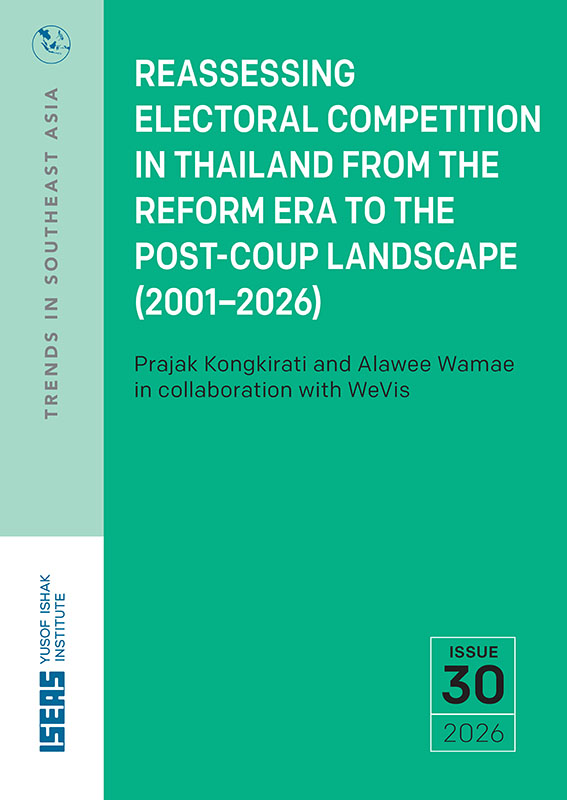
Reassessing Electoral Competition in Thailand from the Reform Era to the Post-Coup Landscape (2001–2026)
Date of publication:
2026
Publisher:
ISEAS – Yusof Ishak Institute
Number of pages:
42
Code:
TRS30/26
Soft Cover
ISBN: 9789815393057

About the publication
- Thailand’s parallel mixed-member electoral system has, across all seven general elections since 2001, allocated roughly 80 per cent of parliamentary seats to constituency Members of Parliament (MPs) and only 20 per cent to party-list MPs—a ratio far more skewed towards single-member districts than the international norm of 50:50 or 60:40. This structural weighting creates powerful incentives for candidate-centred campaigning, factional politics and the recruitment of locally embedded vote-getters.
- Using Margin of Victory (MOV)—the vote-share gap between the winner and the runner-up in each constituency—as a diagnostic tool, analysis of six elections (2001–26) reveals a highly fluctuating competitive landscape. Competition peaked in 2019 under the single-ballot system, with a national median MOV of 10.1 per cent, and it declined most sharply in 2026, as reflected in the median MOV rising to 17.9 per cent.
- Regional competitive dynamics have reversed dramatically over the last twenty-five years. The South transformed from a near-total Democrat Party monopoly into Thailand’s most fiercely contested region. Bangkok and the Central region shifted towards lower competitiveness through urban consolidation behind the progressive People’s Party. The Northeast fractured: the Upper Northeast saw Pheu Thai’s dominance unravel, while the Lower Northeast consolidated under the Bhumjaithai Party.
- The 2026 decline in nationwide competitiveness is primarily driven by the Bhumjaithai Party’s absorption of MPs from collapsing military-aligned parties and small-sized parties, converting previously contested districts into provincial strongholds. Within constituencies it won, Bhumjaithai’s median MOV rose from 14 per cent in 2019 to 28 per cent in 2026 across the North and Northeast, pointing to deepening dominance rather than narrow victories.
- Despite this consolidation, Thai electoral politics remains fundamentally volatile. The winning party has changed in every election since 2019, and no single party has secured nationwide dominance. The recurring pattern of coups and party dissolutions functions as a competitive “reset” that continually scrambles party alignments and electoral rules. This repeated disruption counteracts the natural consolidating tendency of single-member district systems, preserving macro-level uncertainty even as individual regions settle into new configurations.
Contents
-
Reassessing Electoral Competition in Thailand from the Reform Era to the Post-Coup Landscape (2001–2026)
[Whole Publication, ISBN: 9789815393057], by Prajak Kongkirati, Alawee Wamae, authors