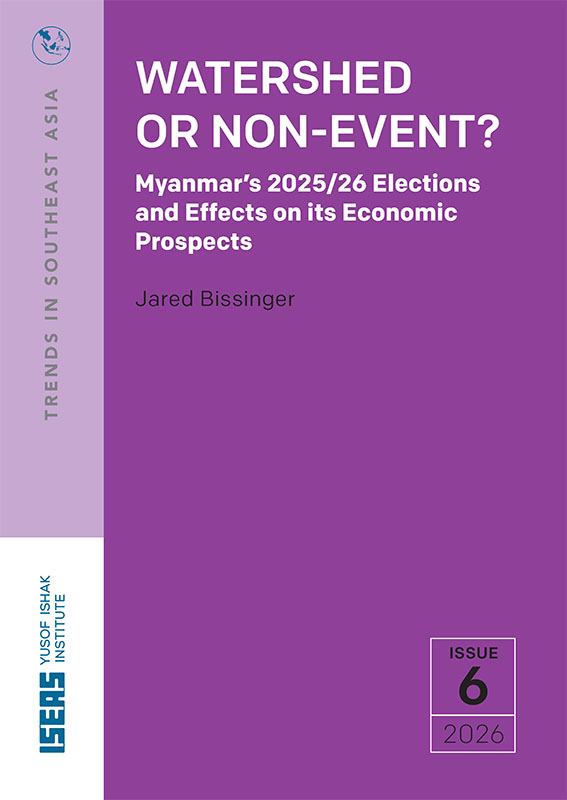
Humanitarian Assistance Meets Economic Realities in Myanmar
Jared Bissinger, author
Date of publication:
2026
Publisher:
ISEAS – Yusof Ishak Institute
Number of pages:
23
Code:
TRS15/26
Soft Cover
ISBN: 9789815361629

About the publication
- Since the 2021 military coup, Myanmar has been experiencing a significant and increasingly complex humanitarian crisis. Humanitarian needs have increased dramatically, rising from about 1 million people in need before the coup to 22 million in 2025—38 per cent of the population.
- Conflict and the country’s 2025 earthquake have been key drivers of humanitarian needs. However, millions of people not affected by either also need humanitarian assistance. This is especially evident in Yangon and Ayeyarwady Regions. In these areas and nationwide, economic policies are a key driver of humanitarian needs. Economic policies are closely connected to conflict—which is the motivation for many of them. However, the humanitarian consequences of economic policies are indirect and nationwide, whereas those resulting from conflict tend to be more direct and geographically concentrated.
- Inflation has made it harder for humanitarian assistance providers to sustain current support, not to mention expand to meet growing needs. A global decline in humanitarian funding further exacerbates the situation, though the depreciation of the Myanmar kyat had, until recently, alleviated some of the country’s inflation-related cost increases.
- The economic drivers of humanitarian needs are long-lasting policies, not a temporary crisis. They will continue to drive needs as long as they remain in place. These policies hurt incomes, diminish returns to work, and undermine facilitating sectors like microfinance. Conflict, another key driver of needs, is also likely to be enduring, suggesting that Myanmar’s humanitarian needs could remain elevated over the long run.
- Given declining funding and the economic dimensions of Myanmar’s humanitarian needs, donors should consider increasing support for development and livelihoods work. This strategic shift should be informed by a thorough understanding of the political economy and its effects on markets, economic opportunities, and the viability of donor-supported programming.
Contents
-
Humanitarian Assistance Meets Economic Realities in Myanmar
[Whole Publication, ISBN: 9789815361636], by Jared Bissinger, author