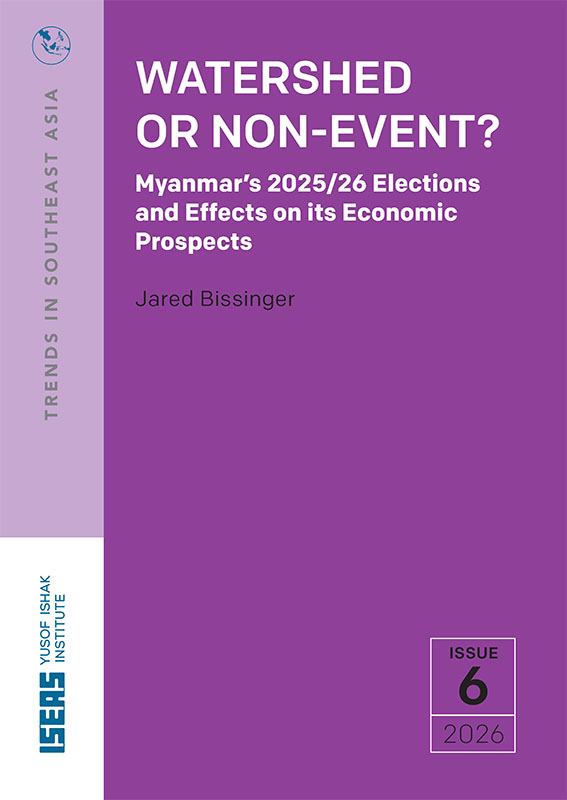
Watershed or Non-event? Myanmar’s 2025/26 Elections and Effects on its Economic Prospects
Jared Bissinger, author
Date of publication:
2026
Publisher:
ISEAS – Yusof Ishak Institute
Number of pages:
24
Code:
TRS6/26
Soft Cover
ISBN: 9789815361476

About the publication
- Few economic actors see Myanmar’s election as fundamentally changing the country’s political situation. However, views on its potential economic effects are more nuanced. For economic actors, a scenario in which an election—however illegitimate—improves stability and predictability is preferable to a scenario in which Myanmar neither returns to democracy nor sees an improvement in stability.
- Despite the lack of democratic credentials, Myanmar’s election may provide a limited economic recovery. This could come from increased clarity about the configuration of power and the key people in decision-making roles, which could help some projects move forward. It could also be driven by increased support from allied countries such as China and Russia. Myanmar may also see new investment in some areas, including cut-make-pack garments and sectors reliant on state contracts, like power production.
- Myanmar’s election is, however, unlikely to transform the country’s economy in the way the 2010 election did. Key constraints—including capital controls, foreign exchange requirements, trade licences, logistics, and electricity shortages—will likely remain, though some relaxations and improvements are possible. A large wave of FDI in internationally competitive sectors, capital-intensive sectors, and sectors with long payback periods is unlikely.
- Migrant entrepreneurs—like other parts of the Myanmar business community—have complex views about the election. While they largely view it as illegitimate, the election in and of itself is not the key factor shaping whether they will return to Myanmar. Instead, economic and security questions will be the key drivers in their decision-making.
- For Myanmar’s economy to return to a trajectory of sustainable growth, numerous policies introduced by the SAC/SSPC will need to be rolled back. Fortunately, the military has an obvious precedent that can guide reforms: the Thein Sein administration’s economic reform agenda. However, the key challenges to economic policy reform are political—not technical—so technocrats will have limited scope to reshape policy without broader political change.
Contents
-
Watershed or Non-event? Myanmar’s 2025/26 Elections and Effects on its Economic Prospects
[Whole Publication, ISBN: 9789815361483], by Jared Bissinger, author