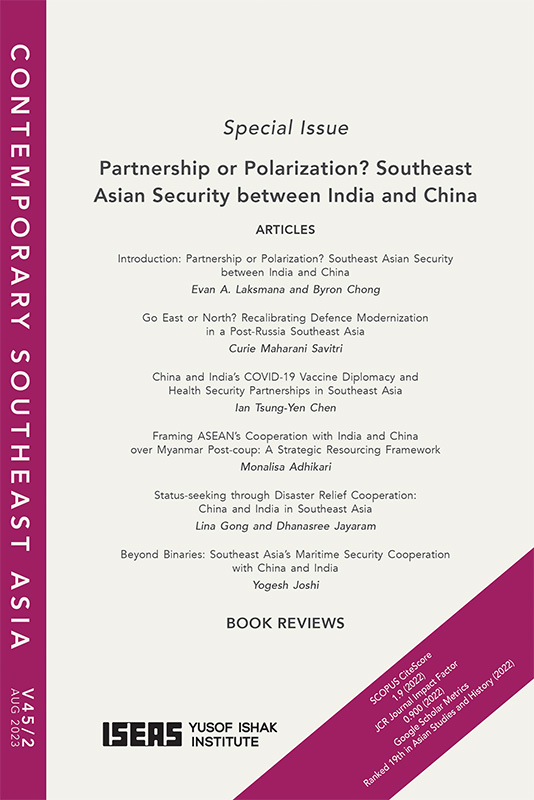
Contemporary Southeast Asia Vol. 48/1 (April 2026)
Date of publication:
February 2026
Publisher:
ISEAS – Yusof Ishak Institute
Number of pages:
223
Code:
CS48/1
Soft Cover
ISSN: 0129797X

Contents
-
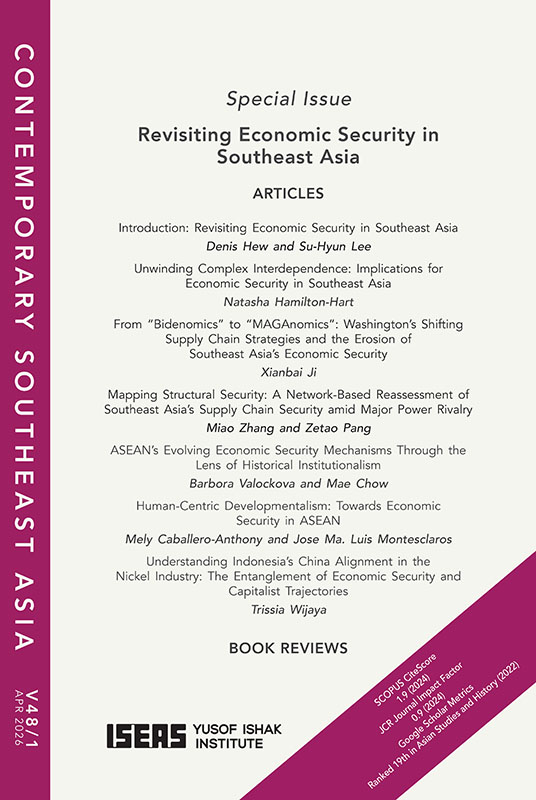
Contemporary Southeast Asia Vol. 48/1 (April 2026)
[Whole Publication, ISSN: 1793284X] -
preliminary pages
- ARTICLES
-
1. Introduction: Revisiting Economic Security in Southeast Asia, by Denis Hew, Su-Hyun Lee, authors see abstractFor decades, the Association of Southeast Asian Nations (ASEAN) has taken a “homegrown” approach to economic security, one that links economic cooperation and integration to regional peace and prosperity. However, the intensification of US-China rivalry and the fragmentation of the international order have exposed the region’s vulnerabilities. This has demonstrated how external shocks and internal development gaps can reshape the region’s economic security landscape. Drawing on insights from the contributors to this Special Issue, the introductory article argues that ASEAN’s traditional market-driven and state-centric approach to economic security is now inadequate. It needs to be recalibrated towards a framework that better supports the region’s long-term resilience, inclusiveness and sustainable development.
-
2. Unwinding Complex Interdependence: Implications for Economic Security in Southeast Asia, by Natasha Hamilton-Hart, author see abstractThe predominant approach to economic security in Southeast Asia has long centred on the security of the state and ruling regime, which in turn has been broadly interpreted to include economic development as a primary source of regime legitimation. The escalation of geopolitical risk and a sharp shift in US trade policies now challenge the region’s economic security strategies. Initially, Southeast Asia benefitted economically from trade and technology competition between the United States and China from 2018, as moves to unwind the structures of complex interdependence linking the two economies resulted in diversion of investment and trade in favour of the region. However, the region has, as a result, become more vulnerable to spillovers arising from the securitization of trade and economic policy by major powers, and particularly since 2025, has been the target of coercive and erratic trade policies adopted by the United States. The environment in which Southeast Asian ruling regimes pursue economic security is thus undergoing a structural shift, as trade and investment patterns are disrupted.
-
3. From “Bidenomics” to “MAGAnomics”: Washington’s Shifting Supply Chain Strategies and the Erosion of Southeast Asia’s Economic Security, by Xianbai Ji, author see abstractThis article explores how the transition of US economic policy from “Bidenomics” to Trumpian “MAGAnomics” is reshaping Southeast Asia’s role in global value chains and undermining the region’s long-term economic security. Whereas the Biden administration pursued supply chain resilience through friend-shoring and multilateral coordination, Donald Trump, in his second term as US president, has embraced an exclusionary and coercive reshoring agenda that weaponizes tariffs and regulatory pressure to repatriate production, regardless of geographic proximity or alliance status. Once a principal beneficiary of the “China+1” strategy, Southeast Asia now faces the spectre of investment diversion, punitive trade enforcement and systemic marginalization. Using a framework that links supply chain politics to economic security and strategic agency, this article argues that Trumpian reshoring is not merely reconfiguring global trade; it is constraining Southeast Asia’s developmental space, curtailing its policy autonomy and eroding its capacity to sustain a meaningful role in global production networks.
-
4. Mapping Structural Security: A Network-Based Reassessment of Southeast Asia’s Supply Chain Security amid Major Power Rivalry, by Miao Zhang, Zetao Pang, authors see abstractSoutheast Asia, long embedded in global value chains, now faces mounting challenges amid escalating strategic rivalry between major powers. This article reconceptualizes supply chain security by introducing structural security—a country’s embeddedness and centrality within global production networks—as a critical yet underexplored dimension of supply chain security. Drawing on trade in value-added data from 2000 to 2020 and employing social network analysis, it develops an analytical framework to evaluate the supply chain security of Southeast Asian countries along both structural and functional dimensions. The R-generated metrics reveal that Singapore, with high centrality and sectoral competitiveness, enjoys strong supply chain security and regional influence. In contrast, Laos and Brunei, characterized by low centrality, concentrated trade structures and high external dependence, exhibit greater vulnerabilities. While strategic competition exerts pressure for global value chain reconfiguration across the region, its effects are far from uniform. This article finds that countries such as Singapore and Malaysia are directly affected by US-China strategic competition, while structurally peripheral economies, such as Brunei and Laos, are less directly exposed due to their trade concentration with neighbouring countries. The asymmetrical effects across Southeast Asia highlight the need to move beyond binary geopolitical framings and to recognize the emerging importance of the Global South. This article’s policy recommendations emphasize reinforcing both structural and functional security and deepening intra-region trade integration as a buffer against external disruptions.
-
5. ASEAN’s Evolving Economic Security Mechanisms Through the Lens of Historical Institutionalism, by Barbora Valockova, Mae Chow, authors see abstractDrawing on official documents, interviews, secondary sources and historical institutionalist theory, this article argues that economic security governance in the Association of Southeast Asian Nations (ASEAN) has evolved through crisis-driven, incremental adaptation rather than fundamental transformation. The pattern is clear: financial crises have prompted incremental innovations in regional financial infrastructure, while trade disruptions have accelerated new integration initiatives, such as the Regional Comprehensive Economic Partnership, and public health emergencies have driven ASEAN towards cross-pillar coordination mechanisms that transcend traditional sectoral boundaries. Each crisis has elicited distinct institutional responses while building on lessons learned from previous experiences. The evolution from sectoral approaches to more integrated mechanisms represents a significant adaptation in regional economic security governance, enabling ASEAN to address increasingly interconnected challenges while maintaining its core governance principles of consensus-building and respect for sovereignty. This adaptive capacity demonstrates how regional organizations can achieve institutional development within existing governance frameworks by strategically leveraging crisis moments as catalysts for cumulative reform.
-
6. Human-Centric Developmentalism: Towards Economic Security in ASEAN, by Mely Caballero-Anthony, Jose Ma. Luis Montesclaros, authors see abstractAmid a global landscape increasingly shaped by geopolitical tensions, pandemics and climate change, economic insecurity is worsening in Southeast Asia. A vast gap has emerged between the evolving vulnerabilities and the region’s approaches to addressing them. This article critiques the failure of states to adapt their liberal economic governance approaches, alongside state-centric measures that continue to treat economic security mainly as an extension of market-led growth. These approaches are increasingly inadequate for today’s systemic and cross-border challenges. To address this problem, this article advances a reconceptualized “human-centric” developmental state (DS) model that places the enhancement of human security at the core of state objectives and argues for a new DS model that prioritizes human protection and empowerment, strengthens social safety nets and broadens embeddedness to include civil society and non-state actors.
-
7. Understanding Indonesia’s China Alignment in the Nickel Industry: The Entanglement of Economic Security and Capitalist Trajectories, by Trissia Wijaya, author see abstractIndustrial policy is back, driven by a global scramble for energy transition minerals (ETMs), green technologies and intensifying geopolitical rivalry. Resource-rich states have sought to leverage the ETM boom to gain greater control over supply chains and bolster economic security. Despite being the world’s largest nickel producer and despite determined efforts to diversify its partners and build a domestically rooted electric vehicles ecosystem, Indonesia has seen a growing Chinese dominance over its nickel industry. Why has this happened, and what has driven Jakarta’s closer alignment with Beijing? This article approaches the puzzle through the lens of uneven and combined development (UCD), arguing that both the path of Chinese investment and Indonesia’s strategic choices are products of intertwined, co-evolving trajectories of capitalist development and the relational character of state power. This has been sustained by three combinatorial socio-political dynamics. First, deregulation in Indonesia’s nickel refining sector, the internationalization of Chinese capital in the “New Three” sectors and profitability pressures affecting key Western players have tightened Indonesia-China economic interdependence. Second, the emergence of a new form of authoritarian politics that safeguards conditions for Chinese companies while simultaneously protecting their Indonesian partners. Finally, new business groups have emerged, centred on Indonesia’s key state-owned enterprises, whose operations and growth strategies are closely tied to Chinese companies.
- BOOK REVIEWS
-
BOOK REVIEW: On the Shadow Tracks: A Journey Through Occupied Myanmar. By Clare Hammond, by Sean Turnell, author
-
BOOK REVIEW: Divergent Worlds: What the Ancient Mediterranean and Indian Ocean Can Tell Us About the Future of International Order. By Amitav Acharya and Manjeet S. Pardesi, by Jaeyoung Kim, author
-
BOOK REVIEW: Southeast Asia Views the United States: Perceptions, Policies, and Prospects. Edited by Ann Marie Murphy., by Hunter Marston, author
-
BOOK REVIEW: Class and Politics in Malaysian and Singaporean Nation Building. By Muhamad M. N. Nadzri., by Chun Sheng Goh, author