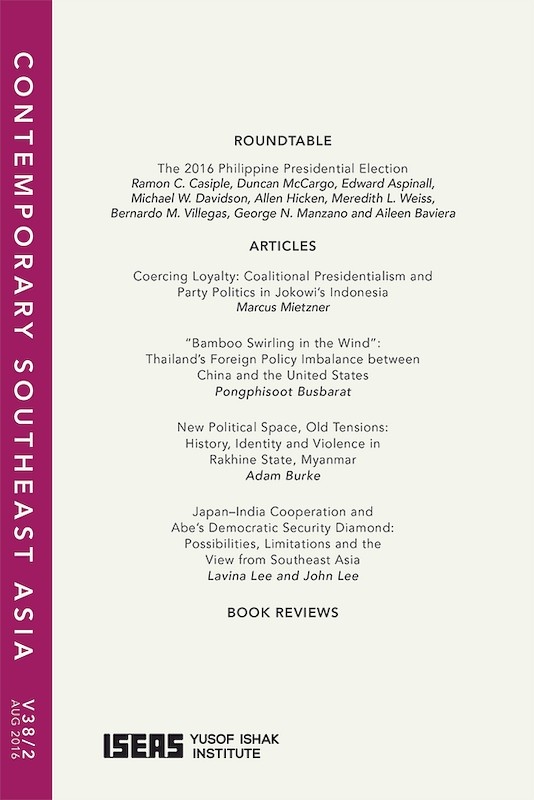
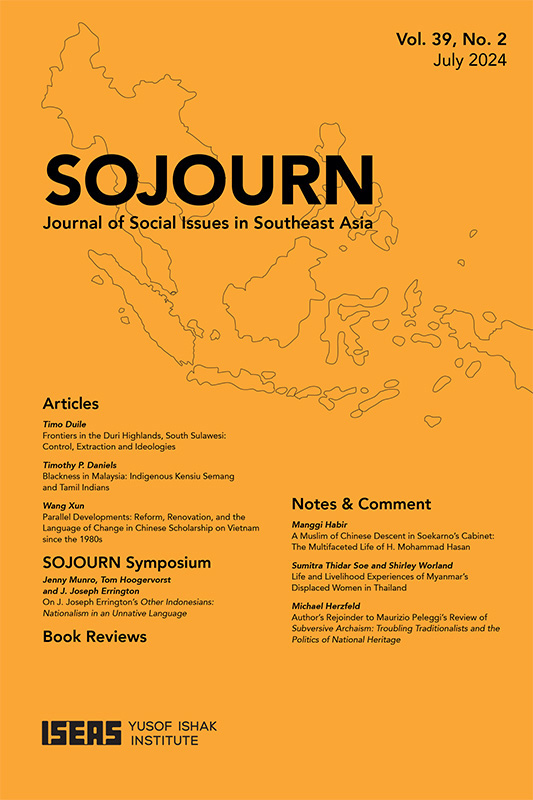
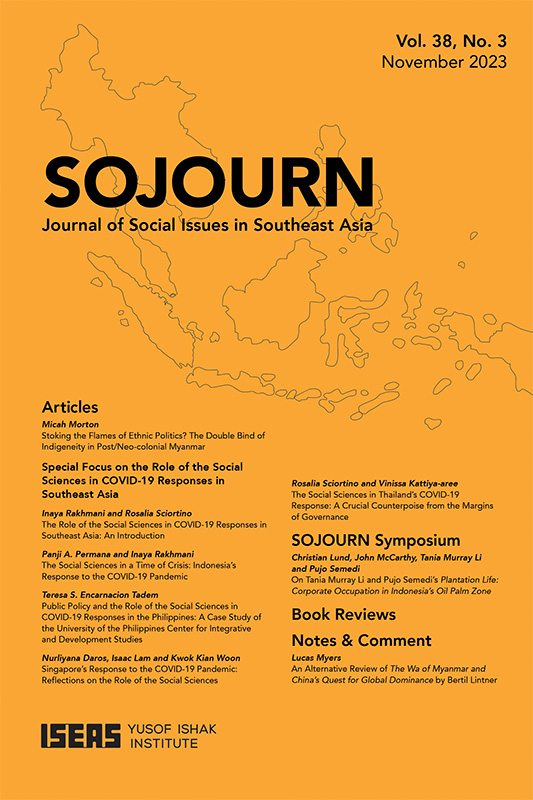
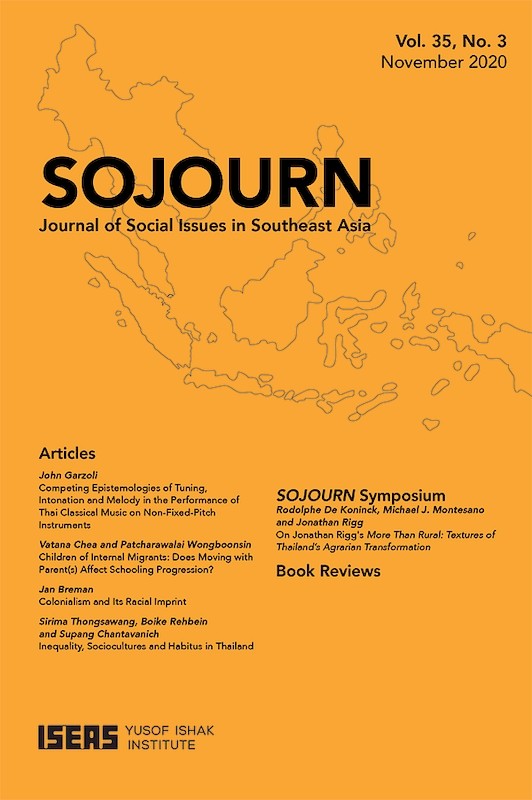
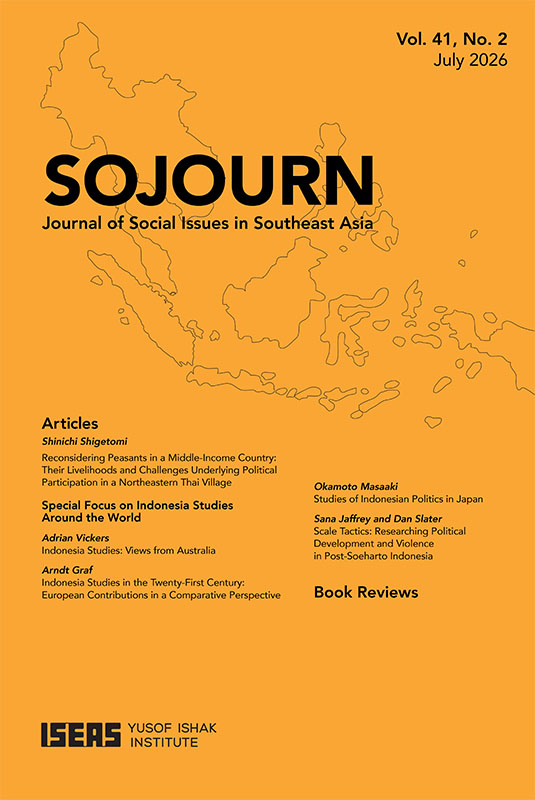
SOJOURN: Journal of Social Issues in Southeast Asia Vol. 41/2 (July 2026)
Date of publication:
July 2026
Publisher:
ISEAS – Yusof Ishak Institute
Number of pages:
183
Code:
SJ41/2
Soft Cover
ISSN: 02179520

Contents
-
SOJOURN: Journal of Social Issues in Southeast Asia Vol. 41/2 (July 2026)
[Whole Publication, ISSN: 17932858] -
Preliminary pages
- ARTICLES
-
Reconsidering Peasants in a Middle-Income Country: Their Livelihoods and Challenges Underlying Political Participation in a Northeastern Thai Village, by Shinichi Shigetomi, author see abstractThis study examines Thailand’s rural conditions underlying intensified farmer activism since the early 2000s, in light of Hayami and Godo’s argument that rural-urban income disparities in middle-income countries generate agrarian unrest. Using the rural livelihood approach, it analyses farm household data from a Northeastern Thai village collected in 1989, 2000 and 2022 to explore how farmers sustain their livelihoods and hardships. The findings show increased dependence on markets and state subsidies, limited business opportunities and unstable offfarm employment among those aged fifty and above—features common among villagers who participated in the Red Shirt political movement, prompting a reconsideration of the image of Thai peasants.
- SPECIAL FOCUS ON INDONESIA STUDIES AROUND THE WORLD
-
Indonesia Studies: Views from Australia, by Adrian Vickers, author see abstractThe Cold War may be long over, but its role in the formation of Indonesia studies, especially in Australia, remains important. Despite the eminence of Indonesia scholarship from other centres, notably Cornell University, Australian studies of Indonesia have the natural advantage of proximity and political engagement with Indonesia. The history of that political engagement in Australia has been shaped by two contrasting perspectives: advocacy for the New Order and a critical Marxist scholarship. Underlying political engagement has been a legacy of studies of language and culture that constituted a more profound engagement with Indonesia. One of the outcomes of that profound engagement has been an increasing prominence of Indonesian scholars in Australia.
-
Indonesia Studies in the Twenty-First Century: European Contributions in a Comparative Perspective, by Arndt Graf, author see abstractOver the last two decades, publications covered by the Web of Science (WoS) have gained importance as a metric for global university rankings, with implications for individual scholars, their universities and countries. Based on WoS data, this article examines the role of European contributions to Indonesia studies in comparative perspective. The findings show that no single European country can match the United States or Australia in terms of overall publication output, although European institutions have increasingly expanded their percentage share in studies of Indonesian culture(s). This article also shows that Indonesia is contributing more WoS-indexed publications related to Indonesia studies, while other Asian countries, including Singapore, China, Japan and Malaysia, are increasingly active in this field.
-
Studies of Indonesian Politics in Japan, by Okamoto Masaaki, author see abstractJapan has its own history of Southeast Asian studies, including studies of Indonesian politics. Its ebbs and flows have been closely tied to the development of Japan’s relationship with Indonesia and Southeast Asia more broadly. This article begins by tracing the historical development of Southeast Asia and Indonesia studies in Japan, focusing on Japan’s relationship with the region. This is followed by an explication of how contemporary Indonesian political studies has evolved in Japan. Japanese scholars have tended to adopt an emic, historical and qualitative approach rather than an etic, comparative and quantitative one. The global trend towards quantitative and comparative approaches in political science, and the rising number of Indonesian scholars working on Indonesian politics, are demanding that younger Japanese scholars of Indonesian politics go beyond an emic approach.
-
Scale Tactics: Researching Political Development and Violence in Post-Soeharto Indonesia, by Sana Jaffrey, Dan Slater, authors see abstractThe classic national monograph has ceased to be the predominant way to study Indonesia in American political science. While scholars of political development have largely “scaled up” to compare Indonesia’s historical trajectory with that of other countries, scholars of political violence have more often “scaled down” to assess fine-grained data and dynamics at the local level. These divergent “scale tactics” involve an eclectic mix of qualitative and quantitative methods. Yet they share a common epistemological goal transcending these methodological differences: identifying empirical variation in pursuit of making robust causal inferences about Indonesian politics. This review article examines both of these streams in Indonesian political studies in the post-Soeharto era, highlighting recurrent themes such as the role of coalitions in political development and the spatial heterogeneity of political violence.
- BOOK REVIEWS
-
BOOK REVIEW: The Chinese in Maritime Southeast Asia: Trade,and Merchant Communities in 17th-century Insulindia by Marie-Sybille de Vienne, by Geoffrey Wade, author
-
BOOK REVIEW: Performing Vulnerability: Risking Art and Life in the Burmese Diaspora by Emily L. Hue, by Nora A Taylor, author
-
BOOK REVIEW: The Politics of Coercion: State and Regime Making in Cambodia by Neil Loughlin, by Lucy Right, author
-
BOOK REVIEW: Bad Lieutenants: The Khmer Rouge, United Front, and Class Struggle, 1970–1997 by Andrew Mertha, by Rachel Jacobs, author
-
BOOK REVIEW: Resonance of Violence: Bersiap and the Dynamics of Violence in the First Phase of the Indonesian Revolution, 1945–1946 by Esther Captain and Onno Sinke, by Rudolf Mrázek, author
-
BOOK REVIEW: Exposed: A Visual History of the Destruction of the Indonesian Left by Geoffrey Robinson and Douglas Kammen, by Gerry van Klinken, author
-
BOOK REVIEW: The Profligate Colonial: How the US Exported Austerity to the Philippines by Lisandro E. Claudio, by Edilberto C de Jesus, author
-
BOOK REVIEW: Bangkok Transformed: An Economic History, 1820–1950 by Porphant Ouyyanont, edited by Chris Baker, by Thomas Bruce, author