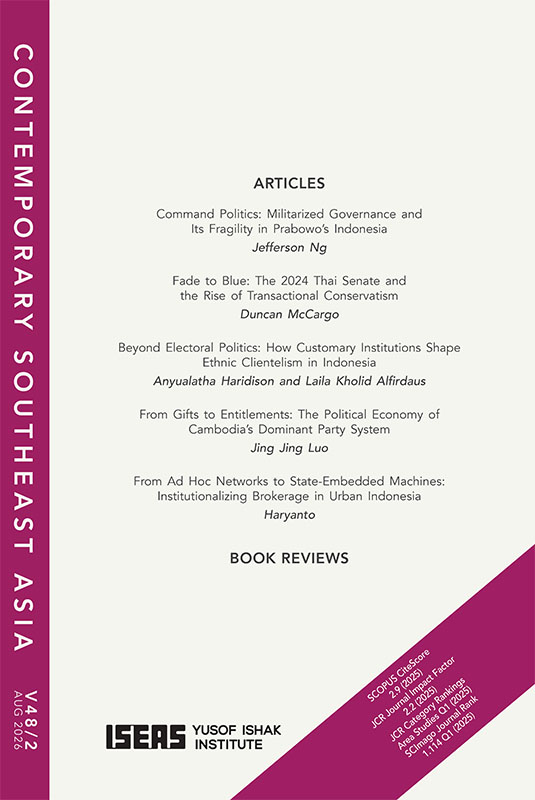
Contemporary Southeast Asia Vol. 48/2 (August 2026)
Date of publication:
July 2026
Publisher:
ISEAS – Yusof Ishak Institute
Number of pages:
154
Code:
CS48/2
Soft Cover
ISSN: 0129797X

Contents
-
Contemporary Southeast Asia Vol. 48/2 (August 2026)
[Whole Publication, ISSN: 1793284X] -
preliminary pages
-
1. Command Politics: Militarized Governance and Its Fragility in Prabowo’s Indonesia, by Jefferson Ng, author see abstractThis article introduces the concept of command politics to analyse how presidential authority is exercised under President Prabowo Subianto. It argues that the Prabowo administration has adopted command politics, a militarized mode of rule, in which the armed forces are repurposed as an instrument of presidential authority. This militarized core is enabled by two supporting mechanisms: the imposition of political control over coalition parties and the empowerment of key loyalists to enforce compliance with presidential directives. This article shows that the administration’s political dominance and persistent governance failures are two sides of the same coin. Command politics’ unified command structure and unity of purpose enable the mass mobilization of manpower and resources but also disable the technocratic deliberation and feedback mechanisms that effective governance requires. Thus far, the mechanisms that generate compliance prevent those failures from generating political consequences, but the administration looks increasingly fragile. The militarization of civilian governance, which builds permanent institutional infrastructure for the military to advance the president’s agenda, is the most consequential and durable transformation of the Prabowo era.
-
2. Fade to Blue: The 2024 Thai Senate and the Rise of Transactional Conservatism, by Duncan McCargo, author see abstractThailand’s new Senate was selected in June 2024 through a complex process ostensibly designed to represent different professional groups. Candidates were nominated at the district levels, and those who qualified effectively became voters, selecting senators from among themselves. In theory, this was a non-partisan mechanism intended to identify the most qualified candidates. In practice, however, political interests became deeply involved in the process. The most successful actor was the Bhumjaithai Party (BJP), whose so-called “blue faction” ultimately secured control of roughly three-quarters of the Senate’s 200 seats. Fewer than 20 senators formed an independent or progressive bloc advocating greater democracy and transparency. The blue faction was particularly focused on influencing the selection of members of key independent agencies, including the Constitutional Court and the Election Commission. Drawing primarily on interviews, this article examines the selection process, performance and internal dynamics of the post-2024 Senate. It also considers the upper chamber’s potential long-term significance for Thai politics following the BJP’s victory in the February 2026 general elections.
-
3. Beyond Electoral Politics: How Customary Institutions Shape Ethnic Clientelism in Indonesia, by Anyualatha Haridison, Laila Kholid Alfirdaus, authors see abstractClientelism in Indonesia has traditionally been analysed through the lens of electoral mobilization and political brokerage. This article argues that ethnic clientelism extends beyond electoral cycles, becoming an institutionalized governance mechanism embedded in customary institutions. By examining the case of the Dayak Customary Council (DAD) in Central Kalimantan, this article explores how ethnic patronage structures regulate access to political legitimacy, economic resources and land control. Unlike conventional political brokers who operate within party-based networks, the DAD functions as a long-term intermediary, mediating power relations between political elites, indigenous communities and corporate actors. Through in-depth interviews, field observations and document analysis, this article reveals that the DAD institutionalizes patron-client exchanges through customary institutions, ensuring the persistence of political and economic patronage. These findings contribute to broader discussions on clientelism, ethnic politics and decentralized governance by demonstrating how non-state actors shape power structures beyond the electoral arena. Understanding these dynamics is crucial for developing policies that promote transparency and accountability in indigenous governance frameworks.
-
4. From Gifts to Entitlements: The Political Economy of Cambodia’s Dominant Party System, by Jing Jing Luo, author see abstractThis article examines Cambodia’s “dominant party authoritarianism” since 1993. Against claims that the ruling Cambodian People’s Party (CPP) sustains its dominance solely through violence and intimidation, it argues that the CPP’s political grip also rests on two successive distributive strategies: initially, patronage-based provision—discretionary, targeted, personalized and often conditional transfers of goods and services by the party and its patrons—and, more recently, programmatic provision, which is rule-based, state-administered, broader in coverage and less reliant on visible personal sponsorship. This shift from patronage to programmatic provision lies at the heart of Cambodia’s contemporary political economy. When poverty and low state capacity prevailed, voters found particularistic, patronage-based distribution acceptable. However, as economic growth raised living standards and expectations, the appeal of patronage politics waned, compelling the ruling party to strengthen state capacity and introduce systematic, nationwide programmatic provisions.
-
5. From Ad Hoc Networks to State-Embedded Machines: Institutionalizing Brokerage in Urban Indonesia, by Haryanto, author see abstractIn the existing literature, Indonesian political machines are mainly seen as informal networks reliant on ad hoc brokers that disband after elections. This article advances the argument that Indonesian politicians can transform these ad hoc campaign networks into enduring political machines embedded at the lowest levels of the state bureaucracy. Based on a case study of the direct election of neighbourhood leaders in Makassar, it explains how this institutionalization occurs through three interrelated mechanisms: bureaucratic mobilization, electoral malpractice and the institutional embedding of campaign networks. These findings offer significant insights into the transformation of Indonesian political machines, shifting from episodic networks of informal brokers to relatively permanent, state-funded structures that mitigate the principal-agent dilemma of political costs and loyalty to brokers. Consequently, this article provides a critical framework for understanding the mechanisms of subnational illiberal practices, illustrating how democratic procedures are strategically co-opted to consolidate enduring political control at the grassroots level.
- BOOK REVIEWS
-
BOOK REVIEW: The Dragon’s Emerging Order: Sino-centric Multilateralism and Global Responses. Edited by Joel Ng, by Ngeow Chow Bing, author
-
BOOK REVIEW: Operation 1027: A Turning Point in Myanmar’s Conflict Landscape. By Myo Naing and Yizheng Zou, by Amara Thiha, author
-
BOOK REVIEW: Rice Politics in Southeast Asia: Legacies of the Green Revolution. By Jamie S. Davidson, by Paul Teng Piang Siong, author
-
BOOK REVIEW: Echoes from the Sino-Burmese Borderlands: Untold Stories of Overland Chinese Migrants During the Cold War. By Wen-Chin Chang., by You Chenxue, author
-
BOOK REVIEW: Notes from the Philippine Underground. By Francisco Nemenzo, by Lorraine Carlos Salazar, author