SOJOURN: Journal of Social Issues in Southeast Asia Vol. 41/1 (March 2026)
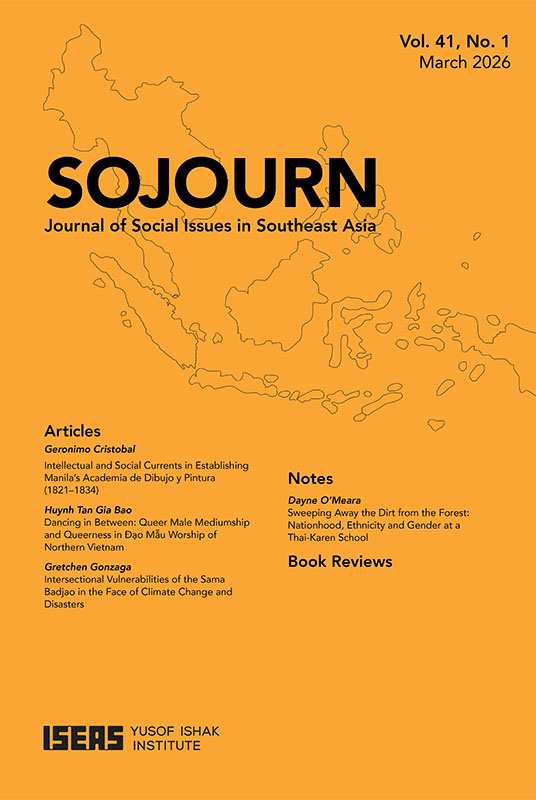
Date of publication:
March 2026
Publisher:
ISEAS – Yusof Ishak Institute
Number of pages:
150
Code:
SJ41/1
Soft Cover
ISSN: 02179520

Contents
-
SOJOURN: Journal of Social Issues in Southeast Asia Vol. 41/1 (March 2026)
[Whole Publication, ISSN: 17932858] -
Preliminary pages
- ARTICLES
-
Intellectual and Social Currents in Establishing Manila’s Academia de Dibujo y Pintura (1821–1834), by Geronimo Cristobal, author see abstractThis essay examines how the Academia de Dibujo y Pintura, the first secular institution for artistic instruction in Southeast Asia, emerged in the 1820s in the Philippines through the interplay of individual agency and broader socio-intellectual currents. While standard accounts credit the Chinese-mestizo painter Damián Domingo (1796–1834) with founding the Academia, this study instead situates him within a wider network of civic organizations, Enlightenment intellectuals and merchant patrons. These historical currents are considered active forces that shaped the institutionalization of art education and the redefinition of artistic labour in colonial Manila. Domingo is recast not as an originator in isolation but as a cultural worker whose practice responded to the liberal ideas circulating among Manila’s educated and commercial elite. The essay also explores how the Sociedad Económica de Amigos del País helped cultivate a creative class that connected the colony to wider imperial circuits, thereby influencing the foundational terms of Philippine art and pedagogy.
-
Dancing in Between: Queer Male Mediumship and Queerness in o Mu Worship of Northern Vietnam, by Huynh Tan Gia Bao, author see abstractThis study explores the intersection of queer identity, societal attitudes and o Mu, Vietnam’s traditional Mother Goddesses worship. Focusing on queer male mediums in northern Vietnam, it examines their roles, challenges and identity negotiation within and beyond rituals. Through interviews, participant observation and social media analysis, the research highlights generational divides among queer male mediums regarding queerness and gender identities. While o Mu offers queer mediums acceptance and community, societal stigmas persist. The findings underscore the importance of representation, and o Mu’s potential as a platform for advocating queer rights, fostering inclusivity and dismantling systemic discrimination in Vietnam.
-
Intersectional Vulnerabilities of the Sama Badjao in the Face of Climate Change and Disasters, by Gretchen Gonzaga, author see abstractThis article examines the impact of intersecting social categories, such as indigeneity, religion and gender, on the recovery capacity after a typhoon of a sea-oriented Indigenous community called Sama Badjao. Drawing on data from ten months of fieldwork in the coastal area of Leyte province, the Philippines, this research uses decolonial and intersectional perspectives to highlight the complex challenges faced by Indigenous women in the aftermath of disasters. The findings show that disasters intensify pre-existing patterns of social inequality, disproportionately burdening Sama Badjao women and delaying their recovery. Limited access to aid resources, healthy and traditional food alternatives, and non-traditional housing materials intersect with customary beliefs, constraining recovery while reshaping Indigenous identity and practice. The article further demonstrates how efforts to reconstruct stilt houses reflect both climate adaptation and contested negotiations of indigeneity and gender in post-disaster contexts.
- NOTES
-
Sweeping Away the Dirt from the Forest: Nationhood, Ethnicity and Gender at a Thai-Karen School, by Dayne O’Meara, author see abstractThis research note presents the everyday encounters of Karen primary school children with Thai nationalism and gender norms. The case studies highlight the different ways children learn about common themes of gender expectations, poverty and being an ethnic minority in Thailand. Through an ethnographic exploration of the shared experiences of play and of growing up Karen in the Thai national education system, the research note examines the ways in which Karen children grapple with the ethnonational baggage of their identity and their home against the ultimately unattainable goals of Thainess that are imposed on them.
- BOOK REVIEWS
-
BOOK REVIEW: State of Fear: Policing a Postcolonial City by Joshua Barker, by Doreen Lee, author
-
BOOK REVIEW: The Camphor Tree and the Elephant: Religion and Ecological Change in Maritime Southeast Asia by Faizah Zakaria, by Deasy Simandjuntak, author
-
BOOK REVIEW: Countering Dispossession, Reclaiming Land: A Social Movement Ethnography by David Gilbert, by Laurens Bakker, author
-
BOOK REVIEW: Enchanted Modernities: Ancestral Vitalizations in the Upper Mekong by Micah F. Morton, by Magnus Fiskesjö, author
-
BOOK REVIEW: A Sense of Place and Belonging: The Chiang Tung Borderland of Northern Southeast Asia by Klemens Karlsson, by Nora A Taylor, author
-
BOOK REVIEW: The Trade-Offs of Legal Status: Safe Migration, Documentation, and Debt in Southeast Asia by Maryann Bylander, by Sasiphattra Siriwato, author
-
BOOK REVIEW: Champassak Royalty and Sovereignty Within and Between Nation-States in Mainland Southeast Asia by Ian G. Baird, by Geoffrey Gunn, author
-
BOOK REVIEW: Public Subsidy, Private Accumulation: The Political Economy of Singapore’s Public Housing by Chua Beng Huat, by Nathan Peng, author