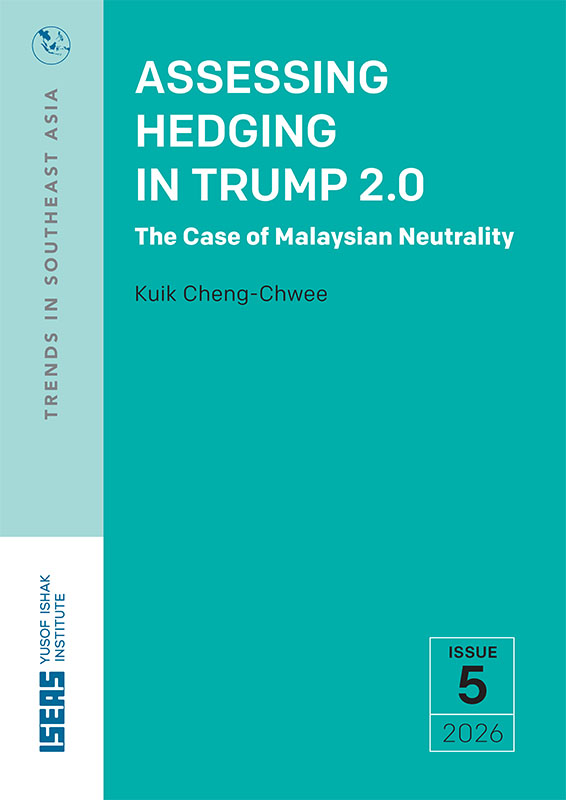
Assessing Hedging in Trump 2.0: The Case of Malaysian Neutrality
Kuik Cheng-Chwee, author
Date of publication:
2026
Publisher:
ISEAS – Yusof Ishak Institute
Number of pages:
24
Code:
TRS5/26
Soft Cover
ISBN: 9789815361452

About the publication
- Malaysia’s decades-long neutrality position is quintessentially a hedging policy, an insurance-seeking policy aimed at mitigating risks by not taking sides, while diversifying partnerships with all powers and cultivating fallback measures.
- However, Malaysia’s Agreement on Reciprocal Trade with the United States, signed in October 2025, entails “poison pill provisions” that may enable Washington to unilaterally terminate that position and prevent Malaysia from forging close ties with China. Some observers have asserted that, amidst the intensifying US-China rivalry and growing big-power pressure, Malaysian neutrality and small-state hedging is no longer possible.
- Malaysian neutrality, as a typical form of small-state hedging, is active, inclusive and adaptive rather than passive, isolative and static. These longstanding features have played out with greater scope and scale under the Anwar Ibrahim administration. Anwar’s charisma has coloured Malaysia’s strategic neutrality, but the country’s diplomatic disposition derives from multiple factors beyond the leader—specifically, historical reasons, structural logic and domestic fundamentals.
- Although the intensifying US-China rivalry is heightening pressures on the weaker actors and incurring a greater price for them to remain neutral, this paper argues that hedging is still possible under the current circumstances because of a combination of three factors: peacetime space, cross-sector offsets and multi-actor activism.
Contents
-
Assessing the Future of Malaysian Neutrality: Hedging Still Highly Possible
[Whole Publication, ISBN: 9789815361469], by Kuik Cheng-Chwee, author